
You have spotted a pond for sale in a private listing. You like the land, the price seems right, and you can already picture yourself by the water. Before signing, be aware that the sale of a pond between private individuals follows a legal process that is much more demanding than a standard real estate transaction. The body of water is subject to water regulations, the preemption rights of the SAFER, and essential administrative checks.
Check the legality of the pond before making any purchase offer
Imagine buying a house only to find out later that it was built without a permit. The same scenario exists for a pond, and the consequences can be severe. State services (DDT, OFB) have been tightening controls on undeclared or non-compliant bodies of water in recent years. A formal notice to restore the site can target the new owner, even if they acted in good faith.
Read also : How to choose between a paper safe and the My Arkevia app for sensitive documents?
Before making an offer, ask the seller for three specific documents. First, the declaration or authorization under the water law, which proves that the body of water was created legally. Next, the receipt of declaration of existence if the pond is old. Finally, any prefectural order related to the structure (dam, dike, sluice).
To fully understand the sale formalities for a pond, keep in mind that administrative compliance conditions everything else: without it, the transaction can be annulled or the new buyer forced to demolish the structure at their own expense.
Further reading : Tips and Essential Steps to Create an Elegant Paved Garden Pathway
A pond termed “founded in title” (existing before the French Revolution) benefits from a special regime, but this does not exempt you from verifying the reality of this right. Demand a written proof, not just a verbal statement from the seller.

SAFER preemption rights and withdrawal period: two steps not to overlook
SAFER has a preemption right on rural land, and a pond located in an agricultural or natural zone falls within this scope. The notary must notify the sale to SAFER, which then has a period to decide whether to purchase it. As long as this period is not expired, the sale cannot proceed.
Why is this so crucial for a private buyer? Because SAFER can propose another buyer or exercise its right to reallocate the land. If you sign a preliminary agreement without this step, the final sale deed will be blocked.
The preliminary sale agreement and the withdrawal period
The preliminary sale agreement for a pond between private individuals follows the same rules as a standard real estate sale. The buyer benefits from a withdrawal period after signing the preliminary agreement. This period starts from the notification of the deed by registered letter.
Use this time to hire an expert or consult the DDT regarding the compliance of the body of water. Once the period has expired, going back can be costly.
Clauses to require in the sale deed of a pond between private individuals
The notarial deed must contain specific clauses that are not found in an ordinary land sale. A generalist notary may not necessarily think of these. Here are the points to include:
- Clause for administrative compliance guarantee: the seller certifies that the pond has all the required authorizations (water law, water police, hydraulic structure). In case of a formal notice after the sale for lack of authorization, this clause entitles the buyer to rescind the sale or seek compensation.
- Clause for the distribution of dredging and decontamination costs: managing polluted sediments represents a costly regulatory obligation. The deed must specify whether previous pollution remains the responsibility of the seller or if the buyer accepts it knowingly, after an environmental assessment.
- Clause on fishing rights: depending on whether the pond is classified as “closed water” or “free water,” fishing rights differ. The deed must mention the exact status and any ongoing fishing leases to avoid surprises after signing.
- Clause on hydraulic structures (dike, dam, sluice): the condition and compliance of these structures engage the owner’s liability. An aging structure may be subject to a work injunction by the prefecture.
Environmental assessment: a necessary precaution
No text currently mandates an obligatory environmental assessment when selling a pond. However, case law shows that the buyer bears the costs of restoration if they did not take precautions before the purchase. Analyzing sediments and checking for pollution (heavy metals, hydrocarbons) protects both the buyer and the seller.
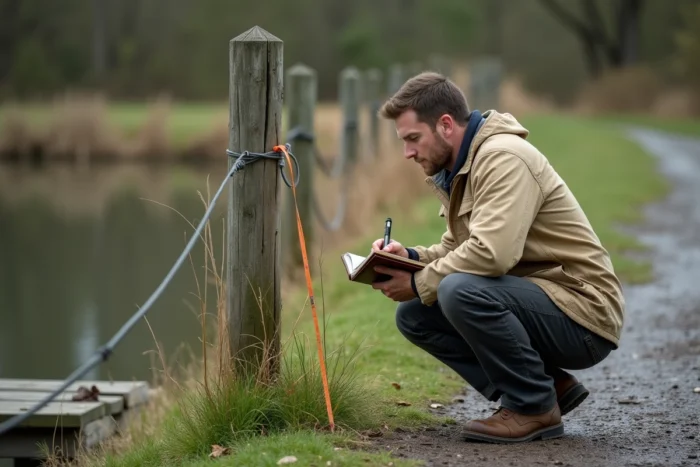
Sale price and the role of the notary in a transaction between private individuals
The estimation of a pond’s price does not follow an official scale. Unlike agricultural land, there is no published grid by agricultural chambers for bodies of water. The price depends on the surface area, water quality, condition of the structures, access, and associated fishing rights.
The notary plays a central role in sales between private individuals. They verify the property’s ownership history, clear the SAFER preemption right, and draft the authentic deed. For a property as atypical as a pond, choosing a notary familiar with rural law makes a real difference. An urban notary may overlook the nuances related to water law or easements for maintaining the banks.
Buyer information: what the seller must provide
The seller has an obligation to inform the buyer. They must disclose any elements that could affect the enjoyment of the property. For a pond, this includes:
- Prefectural or municipal orders applicable to the body of water
- Any ongoing disputes with neighbors or administrations
- The results of previous drainages and the obligations for reserved flow downstream, if the pond is connected to a watercourse
A failure to meet this information obligation can constitute fraud or a hidden defect, giving rise to the rescission of the sale or a reduction in price.
The sale of a pond between private individuals relies on a balance between trust and verification. The clauses of the notarial deed are the only safety net for the buyer against administrative and environmental risks that the seller themselves may be unaware of. It is better to have a well-drafted preliminary agreement than to face litigation in court.