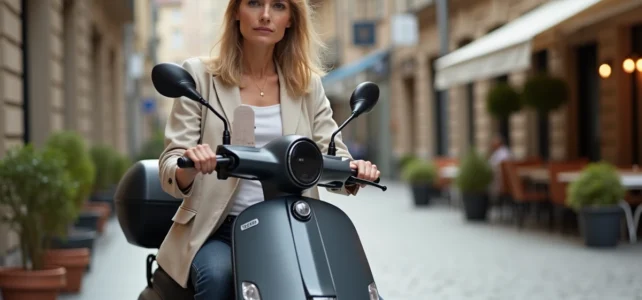
Unlicensed vehicles fall into two distinct categories: 50 cc scooters (or electric equivalents) and unlicensed cars, referred to as light quadricycles. Their common point is a maximum speed limited to 45 km/h and the requirement for an AM license for anyone born after December 31, 1987. Beyond this regulatory framework, the two vehicles cater to very different uses, budgets, and technical constraints.
Technical inspection and Euro 5 standard: what changes for unlicensed vehicles
Competing guides often overlook recent regulatory developments. Technical inspections, long reserved for conventional cars, now apply to light quadricycles. This requirement alters the economic calculation of a purchase, particularly in the used market: a used unlicensed vehicle must have a valid technical inspection at the time of sale, just like a standard car.
Further reading : Everything You Need to Know About Installment Payments at Leclerc: Guide and Tips
On the scooter side, the Euro 5 standard has tightened approval requirements regarding pollutant emissions. The oldest thermal models can no longer be sold as new, pushing the market towards cleaner engines or electric options. For a buyer, this means that a new thermal 50 cc scooter now costs more than it did a few years ago, as manufacturers have passed on the compliance cost.
Before comparing available models, specialized platforms like scootauto.fr allow filtering the offer by vehicle type, engine, and budget, simplifying the initial selection step.
You may also like : Everything You Need to Know About Regional Council Training Assistance: Key Criteria and Steps
Electric or thermal unlicensed vehicle: the market has shifted since 2024
The segment of unlicensed cars has experienced a rapid shift towards electric. According to Automobile Propre, 75% of unlicensed vehicle sales in 2025 were electric models. This figure reflects both the offerings from manufacturers (Citroën Ami, electric ranges from Aixam and Ligier) and the practical advantages for users.
The charging cost of an electric unlicensed vehicle is around €2 for 100 km, compared to a significantly more expensive gasoline fill-up for a thermal quadricycle. Access to low-emission zones (LEZ), which are multiplying in major French urban areas, is another decisive argument. An older thermal quadricycle may find itself banned from certain city centers.
What electric changes in daily life
Range remains the main point of concern. Most electric unlicensed vehicles offer between 70 and 100 km of real range, which is suitable for commuting in suburban areas but limits longer outings. Charging is done via a standard household outlet, without the need for a specific charging station.
Sound comfort is often an underestimated advantage: an electric unlicensed vehicle is nearly silent, reducing fatigue during daily commutes. Maintenance is also simplified (no oil changes, no timing belts), although the cost of battery replacement remains a long-term consideration.
50 cc scooter or unlicensed vehicle: concrete selection criteria
The question is not just a matter of personal preference. Several technical and practical criteria objectively guide the choice.
- Passive safety: the unlicensed vehicle has a closed cabin with seat belts, and sometimes airbags in newer models. The scooter exposes the rider to the elements and direct impacts. Accident data shows significantly lower accident rates for small cars.
- Purchase cost: a new 50 cc scooter remains accessible at a few thousand euros, while a new unlicensed vehicle is in a significantly higher price range. The gap narrows in the used market, especially for thermal unlicensed vehicles that have depreciated due to the rise of electric options.
- Parking and maneuverability: the scooter can weave and park anywhere. The unlicensed vehicle, despite its compact size, requires a standard parking space, which can be problematic in city centers.
- Passenger transport: the unlicensed vehicle accommodates a passenger in a protected cabin, while the scooter requires a passenger to be exposed and wearing a helmet.
The case of teenagers from 14 years old
For a teenager obtaining their AM license, the choice between a scooter and an unlicensed vehicle also involves parental responsibility. The small car offers unmatched protection in the event of a collision, a significant argument compared to a two-wheeler. The higher purchase cost is partially offset by sometimes lower insurance premiums for an unlicensed vehicle than for a scooter, as insurers take into account the lower accident rate.
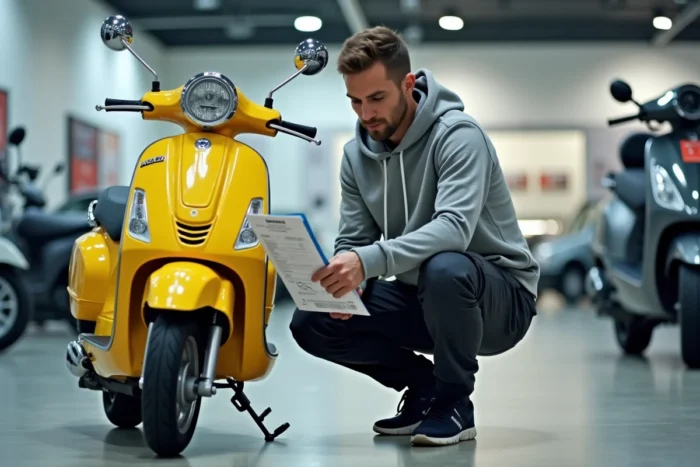
Used purchase: traps to check on an unlicensed vehicle or scooter
The used market for unlicensed vehicles has specificities that buyers of conventional cars may not always suspect.
For a used unlicensed vehicle, the now-mandatory technical inspection serves as a first filter. Check the validity date and any required re-inspections. Beyond this document, three points deserve special attention:
- The condition of the transmission: unlicensed vehicles use variators or automated gearboxes, which are expensive to replace. A whistling noise during acceleration often indicates a worn variator belt.
- Corrosion of the chassis: light unlicensed vehicles use aluminum structures or thin steel tubes, which are susceptible to rust in coastal or salty areas.
- For an electric model, the condition of the battery determines the actual value of the vehicle. Ask for the number of charge cycles and test the effective range before purchase.
For a used 50 cc scooter, the actual mileage is difficult to verify (the odometers are easily tampered with). The condition of the brakes, tires, and rear suspension provides a more reliable indication of the vehicle’s actual use.
The choice between a scooter and an unlicensed vehicle ultimately depends on three variables: the initial budget, the type of daily trips, and the desired level of protection. The rise of electric options in the unlicensed vehicle segment reshapes the economic equation, making the cost of use comparable to that of a thermal scooter while offering a closed cabin. For a first vehicle, this factor deserves consideration before settling on one format or the other.