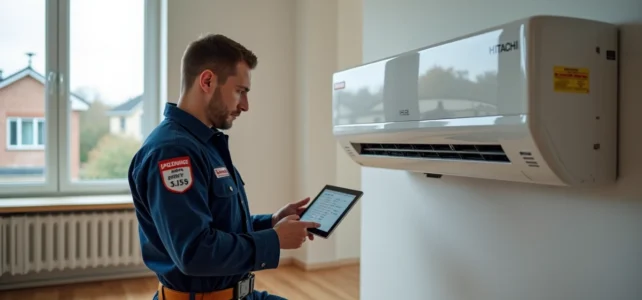
On Hitachi PACs, particularly the Yutaki ranges, most error codes related to installation stem from a discrepancy between the software settings of the remote control and the physical configuration of the hydraulic or refrigeration circuit. We observe that technicians often focus on hardware components while the cause is purely declarative in the settings of the wired remote control.
PC-ARFH1E Remote Control Settings and Hitachi PAC Error Codes
The April 2024 revision of the PC-ARFH1E wired remote control manual (reference PMFR0602 rev.1) has modified several configuration sequences that directly condition the appearance of certain codes. An installer relying on an earlier manual risks triggering communication or sensor configuration faults without any hardware component being at fault.
You may also like : Complete guide to easily and securely access the Arkevia client area
The codes related to sensors and water law are the first affected. If the sensor configuration in the remote control does not match the actual number of connected sensors, the system generates an error that wrongly points to a sensor replacement. We recommend systematically checking the version of the technical document used before any intervention on a sensor or communication type fault.
To accurately identify each fault according to its context of occurrence, the complete list of Hitachi PAC error codes related to installation and daily use remains the reference to consult first.
Related reading : Understanding the Different Types of Family Conflicts and How to Prevent Them Effectively
Another common pitfall concerns the DIP switch settings on the outdoor unit board. These micro-switches define the declared capacity of the unit and its mode of operation. An inconsistency between the position of the DIP switches and the remote control settings is enough to trigger a code 31 (capacity incompatibility between the outdoor unit and indoor units) or a code 03 (communication fault).
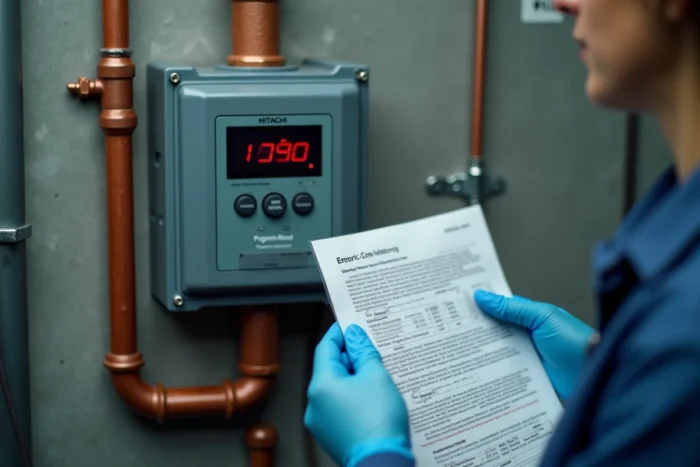
Hitachi Yutaki Error Codes Related to the Hydraulic Circuit
Code 08, often summarized as “outlet temperature too high,” does not always indicate a refrigerant shortage. In Yutaki installations connected to underfloor heating, insufficient hydraulic flow produces exactly the same symptom. The circulation pump may operate without triggering a specific fault, but if the actual flow is below the threshold required by the exchanger, the gas temperature at the compressor outlet rises beyond the programmed limit.
Before suspecting a refrigerant leak, we check three points on the water circuit:
- The pressure of the expansion vessel: too low a pressure reduces the effective flow without causing an immediate low-pressure alarm
- The condition of the strainer filter on the hydraulic return: partial clogging is enough to drop the flow below the critical threshold, especially mid-season when the PAC runs at reduced load
- The setting of the circulation pump speed: in some installations, the pump is limited to a low fixed speed to reduce noise, which becomes problematic in full power heating mode
Error code 70, regularly associated with a “water problem” in general lists, actually covers several distinct situations. It can indicate a flow fault, a water temperature sensor fault, or a problem with the motorized three-way valve. Diagnosis requires cross-referencing the code with the real-time values displayed on the remote control (supply, return, setpoint temperatures) to isolate the cause.
Three-Way Valve and Recurring False Faults
On Yutaki S Combi systems, the three-way valve manages the switching between heating and domestic hot water production. A partial seizure of this valve causes intermittent codes that disappear upon restart, giving the impression of a random fault. The typical symptom: the PAC operates normally for several hours, then displays a code 70 or 45 that clears after a power cut of a few minutes.
This intermittent behavior often leads to the replacement of the electronic board, while the problem comes from a mechanical actuator costing a few dozen euros.
Communication Faults Between Indoor and Outdoor Hitachi Units
Code 03 is the most common fault on new installations. It encompasses all connection issues between the units. The most common cause remains a wiring error, but in installations that have passed commissioning without issues, a code 03 appearing several months later points to other avenues.
The length of the communication cable plays a direct role. Beyond the maximum distance specified by Hitachi for each range, signals progressively degrade. The fault may only appear in winter, when compressor demands increase and current draws disturb the communication line if it runs near the power cable.
- Physically separate the communication cable from the power cable, with a minimum gap of a few centimeters and, if possible, a distinct routing
- Check for the absence of intermediate connections on the communication cable: each junction adds resistance that degrades the signal
- Monitor the voltage between the communication terminals on the outdoor unit board, with the motor stopped and then running, to detect any disturbance related to the compressor startup
Resetting and Limits of the Reset on Hitachi PAC
Cutting the power for a few minutes and then restarting the PAC clears most displayed error codes. This action does not resolve anything if the fault is physical, but it has real utility in a specific case: after a brief power cut, the system may get stuck on a phantom code that does not correspond to any active fault.
In contrast, a code that consistently reappears after each reset indicates a persistent problem. Repeating power cuts in this case unnecessarily stresses the compressor during restart phases and can worsen an already degraded situation, especially on models equipped with a scroll compressor sensitive to repeated cold starts.
On recent Yutaki models, the remote control keeps a history of the last faults. Consulting this history before resetting helps avoid losing diagnostic information. Photographing the remote control screen before any manipulation remains the most useful reflex to pass on to the occupants of the dwelling.