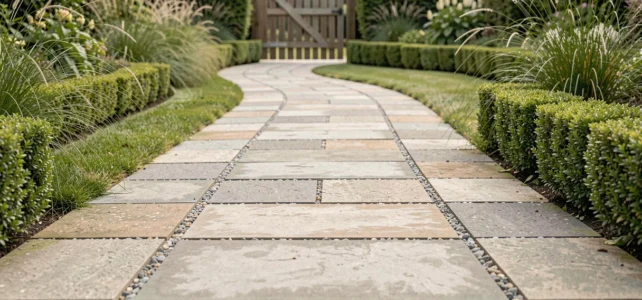
A durable slab walkway depends on three parameters that most guides overlook: the drainage capacity of the base, the choice of joint, and compatibility with local rainfall constraints. Before even selecting a slab format, we recommend consulting your municipality’s rainfall zoning, as urban planning rules related to net zero artificialization now dictate the type of installation allowed.
Rainfall zoning and slab walkway: the constraint that guides ignore
There is no national obligation requiring a property owner to make a new or existing walkway permeable. The constraint comes from local authorities.
Related reading : Tips and Tricks for Safely Supporting Baby's First Steps
Since 2023-2024, many municipalities are tightening their local urban plans (PLU and PLUi) to impose a minimum percentage of non-impermeable surfaces. In practical terms, a project for a walkway made of solid concrete slabs laid on a screed can be rejected or subjected to compensations (swales, infiltration wells) if the land exceeds the impermeable surface threshold set by the rainfall zoning.
This regulatory pressure influences the design from the outset. Cellular slabs, slabs on sand beds with open joints, or permeable pavers become the default options in the affected areas. Before ordering anything, we advise checking the rainfall zoning regulations with your town hall or intercommunal authority: a non-compliant walkway can lead to a refusal of compliance during a resale or an extension.
Read also : Everything You Need to Know About Installment Payments at Leclerc: Guide and Tips
To delve deeper into the installation method suited to these requirements, creating a garden walkway with slabs on a sand bed with permeable joints remains the simplest solution to bring into compliance.
Foundation structure for slabs: sand bed, gravel base, or compacted gravel
The choice of foundation determines the longevity of the walkway far more than the surface material. A slab laid on an inadequate base will become loose after two winters.
Pedestrian walkway: stabilized sand bed
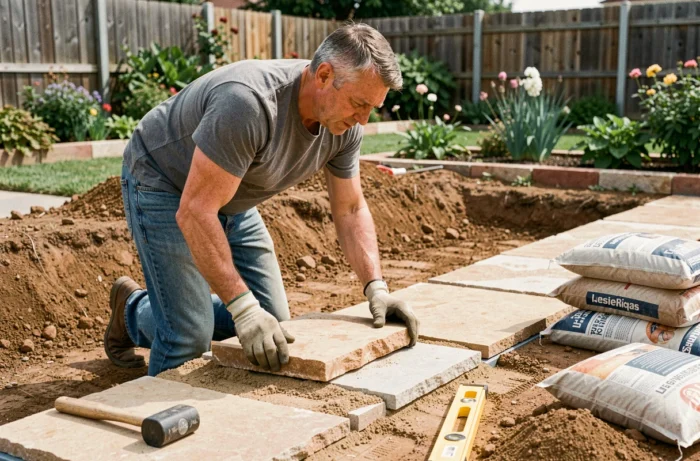
For strictly pedestrian use, a excavation depth equivalent to that of a spade is sufficient. The base receives a geotextile, followed by a layer of compacted crushed gravel, topped with a stabilized sand bed (dry sand-cement mix) a few centimeters thick. The slabs are laid directly on top, secured with a mallet.
The geotextile prevents fine particles from rising and limits weed growth between the joints. Be careful to choose a sufficiently dense weight: a too-light felt will puncture under the stones and lose all effectiveness after a few seasons.
Driveable walkway: draining gravel base required
As soon as a vehicle circulates, the structure changes radically. A gravel base (layer of calibrated crushed stone) must be mechanically compacted, topped with a 0/20 gravel layer and then the laying bed. Without mechanical compaction, the slabs shift and crack under load.
- Excavate to a depth significantly greater than that of a pedestrian walkway to accommodate the gravel base and gravel
- Compact each layer with a vibrating plate in successive passes
- Provide a minimum lateral slope for surface water drainage towards a collection point or a swale
- Install rigid borders (concrete, corten steel, stone) before the slabs to contain the structure
The border is not a decorative accessory. Without a lateral stop, the gravel migrates and the walkway gradually widens.
Natural stone, pressed concrete, or porcelain stoneware: technical selection criteria
The material of the slab is chosen by crossing three criteria: frost resistance (frost classification), surface roughness (anti-slip classification), and compatibility with permeable joints.
| Material | Frost Resistance | Maintenance | Joint Permeability |
|---|---|---|---|
| Natural stone (granite, schist, sandstone) | Variable depending on porosity | Low, possible moss in shaded areas | Excellent when laid on sand |
| Pressed / reconstituted concrete | Good if waterproofed | Moderate, annual high-pressure cleaning | Good with sand joints |
| Outdoor porcelain stoneware | Very good (almost no absorption) | Very low | Medium, finer joints |
Porcelain stoneware is gaining ground for pedestrian walkways due to its almost complete lack of porosity, but its standard thickness requires a perfectly flat base. Even the slightest irregularity in the laying bed results in the slab shifting underfoot.
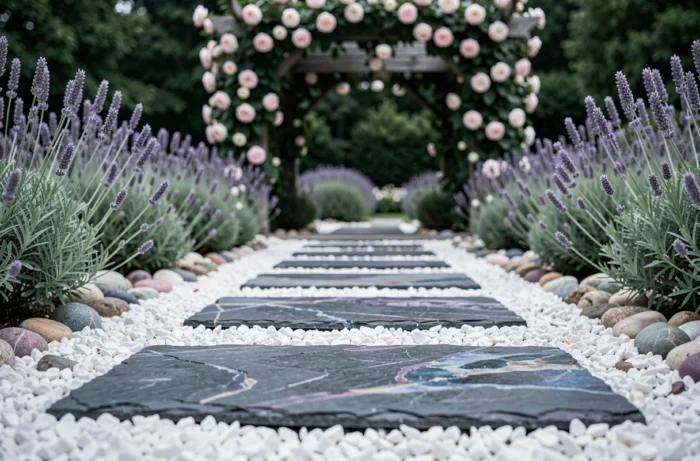
Natural stone remains the most suitable choice when the local urban plan requires permeable surfaces. Its surface irregularities naturally create wide joints that facilitate infiltration.
Joints and finishes: the detail that changes durability
The joint is not just an aesthetic question. Its type determines the lateral stability of the slabs, the permeability of the walkway, and the frequency of maintenance.
Polymer sand joints offer good resistance to weeds and withstand leaching, but they partially waterproof the surface. In areas subject to strict rainfall zoning, this type of joint can be problematic. Classic sand joints, on the other hand, remain permeable but require regular replenishment.
We observe that the most common compromise is a natural sand-lime joint, which hardens slightly without completely blocking infiltration. This type of joint is suitable for pedestrian walkways made of natural stone or pressed concrete, in a garden where drainage remains a priority.
- Polymer sand joint: maximum stability, reduced permeability, suitable for driveable walkways
- Classic sand joint: total permeability, annual replenishment, suitable for Japanese stepping stones
- Sand-lime joint: durability/drainage compromise, suitable for pedestrian walkways with slabs
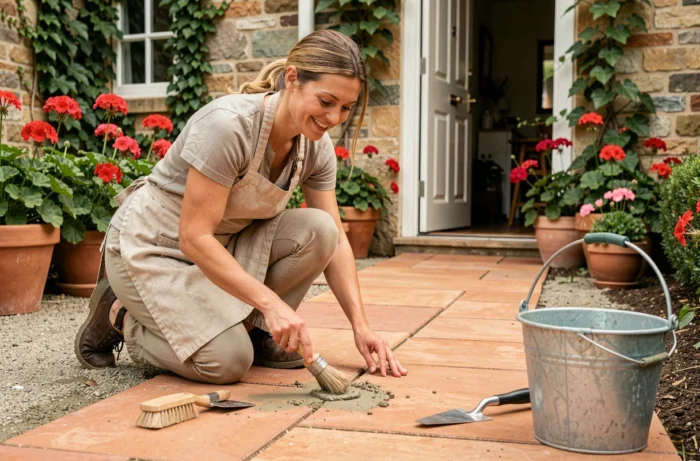
In all cases, jointing is done on dry, clean slabs, in dry weather. Jointing on wet slabs causes whitish veils that are almost impossible to remove from natural stone.
The longevity of a slab walkway depends less on the price of the material than on the rigor applied to the foundation, the choice of joint, and the verification of local rainfall zoning. A well-prepared project on these three axes avoids costly repairs and regulatory surprises.