Water damage in an office, a stolen phone during transit, a hasty departure from a company without retrieving pay slips: these concrete situations raise the question of storing sensitive documents. Whether it’s a paper safe or the My Arkevia application, the choice depends less on technological preference than on very practical constraints related to your daily life.
Probative value and retention period: what paper no longer guarantees alone
It is often thought that a paper document stored in a fireproof safe automatically retains its legal value. This is true for the original of a notarized deed or a handwritten will. But for the majority of everyday documents (pay slips, contracts, certificates), the probative value mainly depends on the ability to prove the integrity of the document over time.
You may also like : How to Start in the Stock Market: Practical Tips and Strategies for Effective Investing
A digital safe certified according to the NF Z42-020 standard meets this requirement by design. It ensures that the deposited file has not been altered since its registration. A binder in a metal safe, however, does not prove that a document has not been altered between two consultations.
La Poste reminds us that a certified HR safe must cover integrity, confidentiality, proof of delivery, and long-term accessibility. These four criteria go beyond the simple logic of physical archiving. When comparing the My Arkevia application for sensitive documents to a paper safe, it is on this dimension of proof that the gap widens the most.
You may also like : Complete guide to easily and securely access the Arkevia client area

Compromised access and phishing: the real risk of the digital safe
On the digital side, the main danger is not the loss of the file. The major risk remains compromised access by a third party. The CNIL 2025 report emphasizes the rapid detection of abnormal behaviors and the enhanced security of identities. A weak password or a successful phishing attempt can open access to the entire safe in a matter of seconds.
With a physical safe, the risk is different: burglary, fire, water damage. The probability is lower, but the consequences are irreversible. You cannot recover a burned birth certificate.
Concrete measures to secure a digital safe
- Activate two-factor authentication as soon as the account is created, not after the first incident
- Never use the same password as for your work email, as it is the most common attack vector
- Regularly check the connection history if the platform allows it, to spot any suspicious access
For a paper safe, security involves a certified fireproof model (minimum 30 minutes protection), fixed to the floor or wall, in a room less exposed to humidity. Feedback varies on the actual resistance of some entry-level safes against prolonged disasters.
Leaving a company and retrieving documents from My Arkevia
One aspect that classic comparisons overlook: what happens when you leave your employer? If your pay slips are stored on My Arkevia via the company’s HR service, access to the safe remains personal and does not depend on the employer. The account is linked to the employee, not the company.
The concrete trap occurs when you have lost your login credentials. After leaving, the HR service can no longer intervene in your personal space. You must have retained your associated email address and recovery codes before returning your badge.
Preparing for the transition before leaving
It is recommended to download a local copy of all documents stored in the digital safe, even if the platform guarantees long-term archiving. Keeping a local copy remains a precaution that digital does not negate. An encrypted hard drive or a secure USB stick in a locked drawer complements the setup well.
This logic of double backup (digital plus physical copy) is not an admission of weakness of the online safe. It is a common-sense rule that applies to any system, including paper: you do not keep a single copy of an irreplaceable document in the same place.
Paper or digital safe: selection criteria based on your situation
Rather than making an absolute choice, one can reason by usage profile.
| Criterion | Paper safe | My Arkevia (digital) |
|---|---|---|
| Accessibility | Only on-site | From any connected device |
| Proof of integrity | Not guaranteed over time | Certified by the NF Z42-020 standard |
| Main risk | Physical disaster (fire, water, theft) | Compromised access (phishing, weak password) |
| Recovery after disaster | Impossible if destroyed | Data replicated on remote servers |
| Original documents required | Suitable (notarized deeds, wills) | Not suitable for original paper required by law |
For documents that require a paper original (certain civil status acts, handwritten wills), the physical safe remains the only option. For everything else, the certified digital safe offers superior security as long as access is managed properly.
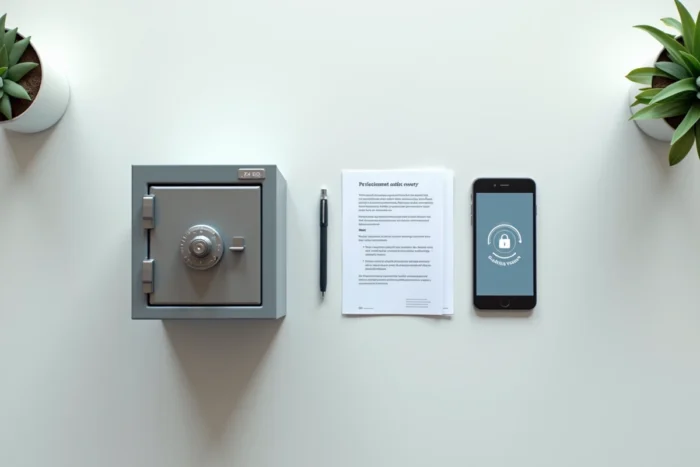
A household or a freelancer managing few sensitive documents can make do with a compact fireproof safe combined with a digital space for pay slips and certificates. A person accumulating professional documents over several years has every interest in centralizing on a certified platform and maintaining an updated local copy.
The choice is not binary. The combination of both, with clearly defined roles between paper and digital, remains the most robust configuration against the uncertainties of daily life.