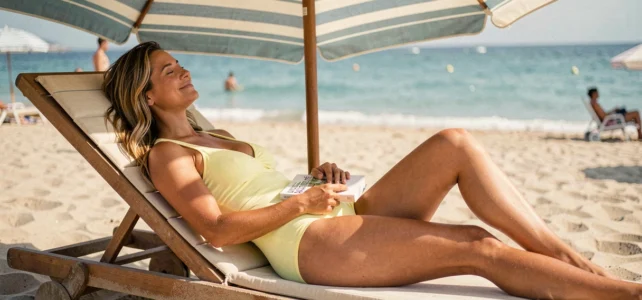
We settle under the parasol, spend three hours reading, and in the evening we discover clear tan lines on our shoulders. The situation is commonplace, yet it still surprises. UV rays do not stop at the edge of the fabric: they bounce off the sand, penetrate certain fabrics, and diffuse into the atmosphere even when we think we are sheltered.
Tanning under a parasol is not a myth, but the result depends on very concrete parameters that most manufacturers do not highlight.
Related reading : How to Avoid Sweating Under a Hat: 8 Tips to Stay Dry
Parasol fabric and UV filtration: what UPF certification really changes
A standard parasol, the one you buy at a supermarket for about twenty euros, does not guarantee any measurable UV filtration. The fabric is designed to provide visible shade, not to block ultraviolet radiation. Therefore, you can tan underneath almost as quickly as in full diffuse sunlight.
UPF (Ultraviolet Protection Factor) certified parasols meet specific standards such as the European standard EN 13758-2 or UV Standard 801. A UPF 50+ parasol blocks more than 98% of UVA and UVB according to professional guides for café and hotel terraces.
Further reading : Tips and Essential Steps to Create an Elegant Paved Garden Pathway
The difference with a non-certified fabric is radical: under a UPF 50+, residual tanning becomes very slow, while under a standard fabric, the skin continues to receive a significant dose of ultraviolet rays.
To know if one can tan under a parasol significantly, we first look at the label. No UPF mention or textile protection index? The fabric allows a considerable part of the radiation to pass through.
Ground reflection: the factor the parasol cannot control
Even under a UPF 50+, you can tan. The explanation is one word: reflection. UV rays bounce off surrounding surfaces and reach the skin from below or from the sides, where the parasol does not cover.
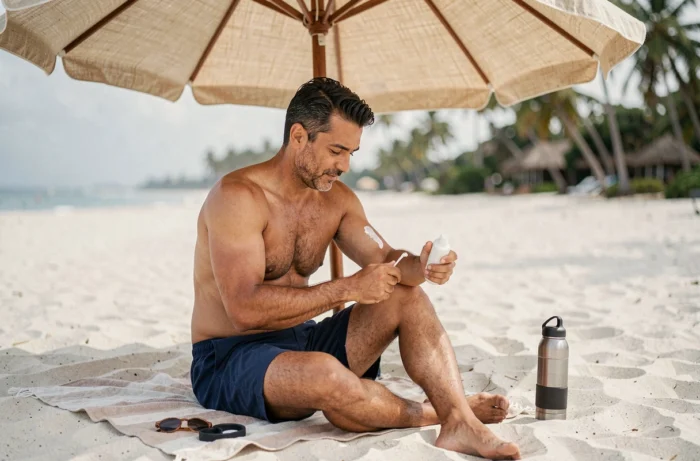
Light sand reflects a notable portion of UV rays. Water does the same, sometimes even more depending on the angle of the sun. The concrete of a terrace or the white tiles of a poolside also contribute to this phenomenon. You find yourself exposed by reflection while perceiving no direct heat, which encourages you to stay longer without protection.
The absence of a heat sensation under the parasol is a trap. You do not feel the burn coming because infrared (heat) is largely blocked by the fabric, but UVA rays pass through or go around the obstacle. This discrepancy between thermal comfort and actual exposure explains the “surprise” sunburns in the evening.
Most reflective surfaces to watch out for
- Dry, light sand, which reflects UV rays towards the upper body (chin, inner arms, under the nose) – areas rarely protected by sunscreen.
- Pool or sea water, whose reflection varies depending on the time and angle of the sun, but remains constant during midday.
- Light terrace slabs or smooth concrete, which create a less known but measurable reflection effect, especially when the parasol is positioned low.
Sun protection under a parasol: actions that change the outcome
We tend to skip sunscreen when we stay under the parasol all day. This is a mistake. Sunscreen remains necessary even in the shade of a certified fabric, precisely because of reflection and atmospheric diffusion of UV rays.
The choice of index depends on the phototype and duration of exposure. For a full day at the beach under a parasol, a high index applied to exposed areas (face, arms, feet, décolleté) limits excessive tanning and especially the risk of burning. We reapply every two hours, just like in full sunlight.
Sunscreen and parasol: combination to adapt to the terrain
On a dark wooden terrace, reflection is low. You can settle for a moderate index if the fabric filters correctly. On white sand facing the sea, the double direct and reflected exposure justifies a maximum index even under a high-end parasol.
Children deserve special attention. Their skin reacts faster to UV rays, and they move: a child “under the parasol” actually spends part of their time at the edge or outside the shaded area. UV-protective clothing (certified UPF t-shirts) effectively complements their protection.

Color and thickness of the fabric: two often misunderstood parameters
It is often said that light colors protect better from the sun. For heat, this is true: a white fabric reflects more infrared and keeps the space underneath cooler. For UV rays, it is the opposite.
Dark and dense fabrics filter ultraviolet radiation better than light fabrics of equivalent weight. A thick black fabric absorbs UV rays instead of letting them pass, while a thin white fabric can transmit a significant proportion. This finding, documented by tests from specialized manufacturers, goes against the usual buying reflex.
The thickness of the fabric is as important as the color. A thin budget polyester, even dark, quickly loses its filtering properties after a few seasons of exposure. A mass-dyed acrylic fabric or a technical fabric with UV treatment retains its effectiveness longer. The principle remains reliable: high weight and dark dye offer the best UV barrier.
Tanning in the shade and skin risk: an exposure that matters
The tanning obtained under a parasol mainly comes from diffused and reflected UVA. These UVA penetrate deeply into the dermis and stimulate melanin production, but they also contribute to skin aging and the long-term risk of skin cancer.
We are not talking about an immediate danger comparable to prolonged direct exposure. However, accumulation over several summers produces measurable effects. Prevention campaigns emphasize this point: shade alone does not provide sufficient protection.
Combining a certified UPF parasol, appropriate sunscreen, and limiting exposure time during the most intense hours remains the most reliable strategy. The parasol is part of the equation, not the entirety.