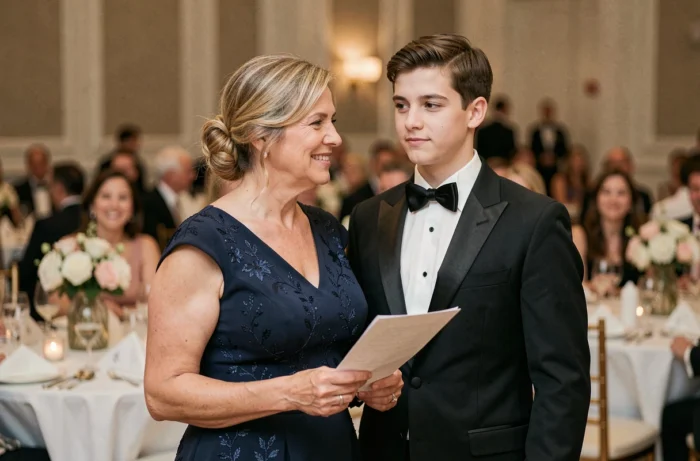
A speech from the groom’s mother is not a toast from a witness nor a love letter read in public. It is a speech addressed to a son, to his partner, and to an entire assembly, all at once. Writing this text requires knowing who you are speaking to, in what order, and especially when to stop.
Calibrating the Duration and Tone of the Groom’s Mother’s Speech
The duration dictates everything else. A recent guide on wedding speeches recommends that parents aim for five to seven minutes of speaking time. Beyond that, the guests’ attention wanes, especially if the speech occurs during the meal.
Five minutes correspond to about 700 words read aloud, with pauses. This framework forces you to make choices: one or two well-told anecdotes are better than a catalog of memories that drags on.
In terms of tone, the trend observed in recent years clearly leans towards simple and personalized formulations. Very formal phrases (“Ladies and Gentlemen, on this solemn day”) are giving way to a more intimate, direct tone. Couples and families today expect authenticity rather than formality. Writing a mother’s speech for her son’s wedding using everyday words does not diminish the impact of the message; on the contrary.

Concrete Structure of a Mother’s Speech for a Wedding
A successful speech relies on three distinct blocks. Each has a specific function, and their sequence creates an emotional arc without the mother needing to force the issue.
The Opening Block: Establishing the Connection
The first two or three sentences serve to establish who is speaking and why. There is no need for a lengthy introduction: everyone knows you are the groom’s mother. A single sentence is enough to anchor the moment.
Example of an opening: “When [first name] was eight years old, he asked me if we could keep a fox in the garden. Today, he has found someone as unpredictable as he is, and that is exactly what he needed.” The anecdote creates an image, and the connection to the present provides the thread.
The Central Block: An Anecdote and a Character Trait
One well-developed anecdote is better than five skimmed over. Choose a memory that reveals a character trait of your son, a trait that his partner will recognize. This bridge between the past and the present gives the speech its depth.
This block is also the moment to welcome the daughter-in-law or son-in-law. Address this person directly, using their name, with a sentence that shows what they bring to your son. Avoid generic phrases like “welcome to the family” without anything personal behind them.
The Closing Block: Wishes for the Couple
Conclude with wishes directed towards the couple, not towards the past. The last words should belong to their future, not to your nostalgia. One or two sentences are sufficient. A raised toast naturally concludes the speech.
Common Mistakes in a Mother’s Wedding Speech
Some pitfalls recur in almost every failed speech. They do not stem from a lack of love, but from a framing issue.
- Addressing only your son while forgetting the rest of the assembly. Guests become spectators of a private moment, which creates discomfort rather than emotion.
- Multiplying childhood anecdotes without ever talking about the adult he has become. The groom is thirty, not six. Recognizing the man he is today gives the speech its accuracy.
- Sliding in disguised reproaches under the guise of humor. A jab about an ex, a comment on how long it took him to decide, a reference to a family conflict: even wrapped in laughter, these elements leave an aftertaste.
- Reading a text word for word, eyes glued to the paper, without ever looking up. Memorizing at least the opening and closing allows for real contact.
Adapting the Speech According to the Moment of the Ceremony
The context in which you speak changes the way you write. A speech given during a secular ceremony has a different rhythm than a toast during dinner.
During the ceremony, the tone is more solemn. Sentences are shorter, and silences matter. The assembly is attentive, often standing or sitting without a glass in hand. Emotion comes more easily, which also means that tears can interrupt speech. Planning a lighter passage in the middle of the text helps regain control.
During the meal, the atmosphere is more relaxed. Humor is better received, and anecdotes can be a bit longer. However, the ambient noise requires speaking louder and shortening the speech. Five minutes becomes an absolute maximum at the table.
In both cases, ask the couple or the officiant exactly when you will speak. Knowing whether you are speaking first, after the witnesses, or at the end changes the tone. A mother who opens the series of speeches sets the emotional tone. One who concludes must be able to gather everything that has been said before her in a few words.
The format of the speech also depends on the personality of the speaker. A mother who is uncomfortable speaking in public can read a short and polished text of three minutes, punctuated by a single glance at her son during the wishes. This will be more impactful than a long improvised speech that drags on.