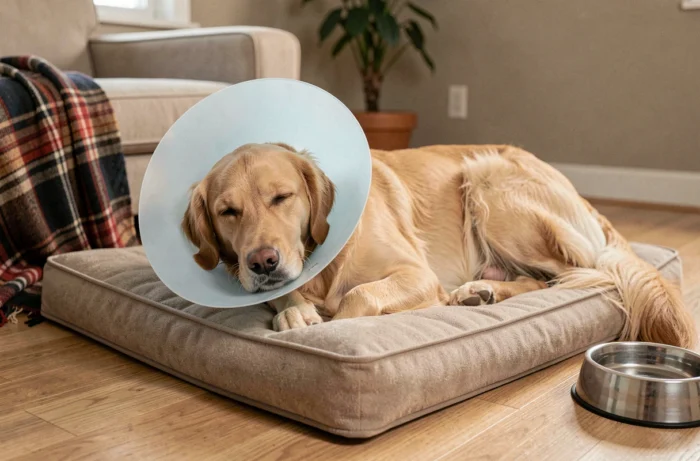
Your dog has just been spayed and seems to be in great shape the very next day. The temptation to resume regular walks is strong. This is precisely where most complications arise: internal healing takes much longer than the animal’s behavior would suggest.
Why rest after spaying lasts longer than one might think
Most guides mention a recovery period of 10 to 14 days. This timeframe corresponds to the removal of stitches or their dissolution. In reality, internal healing continues well beyond two weeks.
By the third or fourth day, many dogs return to nearly normal behavior. They want to run, jump, and play. This discrepancy between external appearance and the actual state of internal tissues can be misleading. The abdominal muscles, vascular ligatures, and deep layers of skin need several weeks to regain their strength.
A detailed article on dog spaying on Boule de Poil reminds us that the most common complications (wound reopening, infection, hernia) occur when activity is resumed too early. It’s not the day of the surgery that poses a problem, but the week that follows.
Spaying a female dog or neutering a male: different recovery times
Both are often grouped under the term “spaying,” but the procedure varies in scope depending on the animal’s sex.
In females, ovariectomy (removal of the ovaries) or ovariohysterectomy (removal of the ovaries and uterus) involves an incision in the abdominal cavity along the linea alba. It is a deep surgery. The recovery of a spayed female requires a longer strict rest than that of a male.
In males, neutering involves an incision in front of the scrotum to remove both testicles. The procedure is more localized, and the wound is less deep. Skin healing remains around 10 days, but caution is still advised: a neutered male continues to produce sperm for about 5 to 7 days after surgery.
Activity resumption schedule week by week
Rather than a single date for “returning to normal,” a gradual approach is much safer. Here is a realistic schedule, adapted to most situations.
The first two weeks: strict rest
Only short leash walks for bathroom needs. No running, no jumping, no stairs. The dog may be drowsy for the first 24 to 48 hours due to anesthesia. Its appetite will gradually return.
At home, limit its movements. For large dogs, a small room serves as a confinement area. For smaller dogs, a suitably sized transport crate works well when you cannot supervise.
Weeks two to four: controlled resumption
Leash walks can be slightly extended, but still without full freedom or intense play. No off-leash time in a park, no running with other dogs. Observe the wound: at this stage, it should be clean, without redness or swelling.
Weeks four to eight: gradual return to normal
This is the least documented phase and yet the most neglected. High-impact activities (agility, ball throwing, canine sports) should only resume after a minimum of four weeks, and gradually. A sudden return to intense exercise risks compromising internal healing.
Warning signs to watch for after surgery
Even with proper rest, some complications may arise. Knowing how to spot them early makes all the difference.
- Redness, swelling, or oozing around the incision beyond the second day, especially if it worsens instead of improving
- Fever, prolonged lethargy, or total refusal to eat more than 24 hours after the procedure
- The dog licks or scratches the wound despite the collar, which can lead to infection or tearing of stitches
- Repeated vomiting or persistent diarrhea in the days following anesthesia
At the slightest doubt, contact your veterinarian. A quick consultation always costs less than a surgical redo.
Collar, protective bodysuit, and daily management
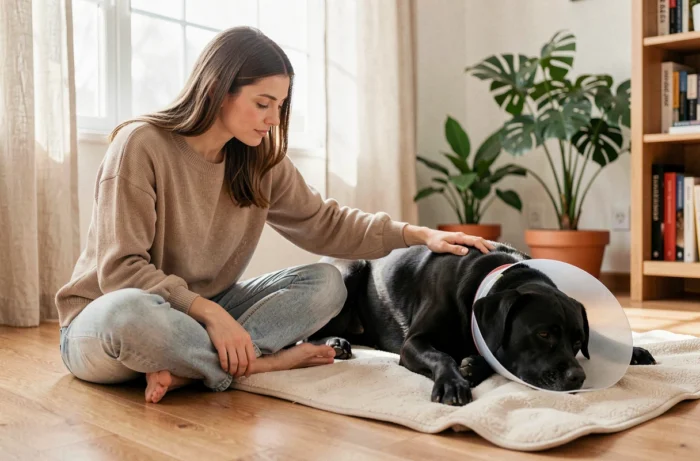
The collar (or Elizabethan collar) remains the most reliable way to prevent the dog from accessing its wound. Many owners remove it too early because the dog seems uncomfortable. The collar should remain in place until the stitches are removed or the veterinarian gives the go-ahead.
An increasingly used alternative is the protective bodysuit, a type of onesie that covers the abdomen. It is better tolerated by some dogs, especially those that refuse to move with the collar. Regularly check that the bodysuit is not rubbing against the incision.
For feeding, offer small amounts in the first hours after returning home. Anesthesia can cause nausea. Return to the usual ration as soon as appetite resumes, keeping in mind that a spayed dog will ultimately have slightly reduced caloric needs.
Post-spaying rest is not just a simple comfort precaution. It is a period where every day counts for the strength of healing. Following the steps, even when the dog begs with its eyes to go run, remains the best investment for its long-term health.