
Television series are no longer just telling tech stories; they are integrating it into their own production. Between artificial intelligence replacing film sets and European regulations imposing new rules, the world of series is experiencing a concrete technological shift. Here are the high-tech trends reshaping this landscape.
AI-Generated Series: Production Without Camera or Actor
Have you ever watched a scene from a series and wondered if it was filmed or created by a computer? The question is no longer hypothetical. In China, the arrival of ByteDance’s Seedance 2.0 model in February 2026 has shifted a large part of serial production towards content entirely generated by artificial intelligence, without actual filming.
The numbers are staggering: out of the 128,000 new series recorded in the first quarter of 2026 in China, 95% are classified as AI-produced. The phenomenon is not limited to micro-dramas intended for smartphones. It also affects longer formats, with increasingly difficult-to-distinguish visual results from traditional filming.
This wave of low-cost, rapid production is disrupting traditional economic models. Where an episode used to require weeks of filming, a small team can now generate comparable content in just a few days. To keep up with these developments at the intersection of series and technology, Série Live’s tech section regularly covers these topics.
Netflix and K-Dramas: AI Enters Platform Catalogs
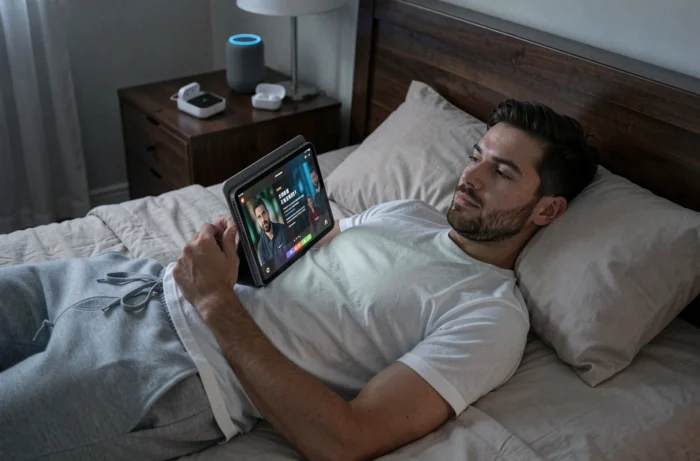
The phenomenon is not confined to East Asia. Netflix has crossed a milestone by integrating AI-generated sequences into South Korean K-dramas. The platform has gone further by launching Bloodbound Luna, its first English-language series entirely produced by AI, following two previous Korean titles that were also fully generated.
Specifically, artificial intelligence is involved at several levels in these productions:
- The script, where language models assist writers in structuring plots and generating dialogues
- Visual effects, with sets and secondary characters created digitally without the use of extras or physical studios
- Dubbing and localization, accelerated by voice synthesis tools capable of reproducing intonations in multiple languages
For viewers, the difference becomes subtle. But for industry professionals, this trend raises profound questions about the future of audiovisual production jobs.
European Regulation on AI and Transparency of Series Content
In the face of this wave of synthetic content, Europe has chosen to legislate. The European AI Act, which is being gradually implemented, now imposes transparency obligations for any content generated by artificial intelligence. Article 50 of the regulation requires clear labeling of synthetic content, including videos.
For streaming platforms, this means one specific thing: if a series or sequence has been produced by generative AI, the viewer must be informed. This obligation does not only concern giants like Netflix. It applies to any provider distributing synthetic content to the European public.
What the AI Act Changes for Series Broadcast in France
The transparency rules target all actors, not just large tech companies. An independent studio that uses generative AI to create sets or characters must also disclose this use. Failure to comply with these obligations exposes one to sanctions provided by the regulation.
This regulation creates a striking contrast with the situation in Asia, where AI production is developing without a comparable framework. The series available in France on international platforms will therefore have to meet requirements that their Asian counterparts currently ignore.

Micro-Dramas and Mass Production: The Format That Charms Hollywood
The model of micro-dramas, these short series designed for smartphone viewing, is no longer an isolated Chinese phenomenon. Hollywood is starting to take a serious interest, attracted by a low-cost production model where AI plays a supportive role.
The micro-drama combines short format, accelerated production, and reduced costs. Each episode lasts a few minutes, the narrative pace is calibrated to retain attention on a phone screen, and AI tools help speed up editing, color grading, and sometimes the generation of certain shots.
This format questions the very definition of what we call a series. When a three-minute piece of content is partially produced by algorithms, broadcast on a mobile app, and watched on the subway, it is far from the experience of a one-hour episode on the big screen. The audience, however, does not seem to mind: the consumption of micro-dramas is increasing across all age groups.
Technologies and New Viewing Habits
The evolution concerns not only the production of series. AI-powered recommendation tools are constantly refining suggestions on platforms. Voice synthesis technologies allow for near-instant dubbing. And the interfaces of streaming applications are increasingly integrating predictive features.
The world of series is undergoing a transformation where technology is no longer just a plot subject but the very engine of creation. The line between filmed content and generated content is gradually fading, and this is perhaps the most profound change the industry has seen since the advent of streaming. The coming months, with the full implementation of the AI Act in Europe and the acceleration of generative tools, will determine whether this convergence produces more inventive series or simply more of them.