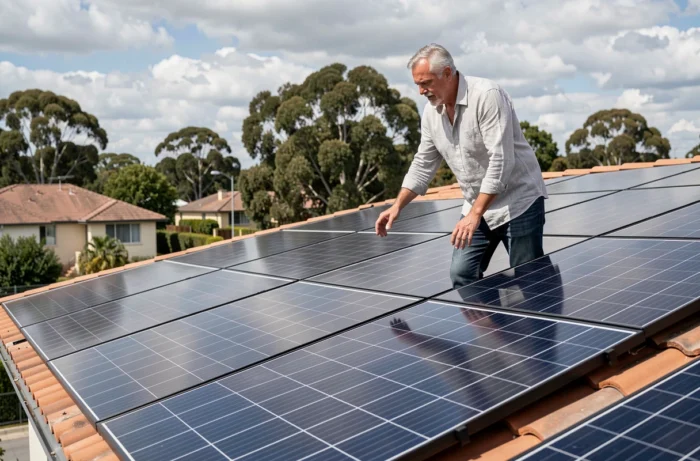
On a south-east facing house in Creuse or the Vosges, a photovoltaic installation can sometimes produce as much as in PACA, provided that self-consumption is increased. Since the reform of June 2026, adopting solar energy for one’s home no longer relies on selling electricity but on a logic of direct savings on the bill. The framework has changed, along with the way to size, make profitable, and manage a residential installation.
Reform S21 and surplus buyback: what changes concretely for residential solar
Until 2025, it was still possible to aim for full sale under 9 kWc with an attractive buyback rate. This option has been closed since March 28, 2025, for small residential installations.
Since June 5, 2026, the self-consumption bonus has been completely removed for any new connection requests. The buyback rate for surplus drops to 1.1 c€/kWh excluding tax, indexed at 2% per year for 20 years. Compared to previous rates, this amount barely covers the metering costs.
The signal is clear: the profitability of a residential solar installation now depends on the amount of electricity consumed by oneself. We are moving from a revenue model (selling back to the grid) to a savings model (avoiding buying from the grid). The resources available on https://energieosolr.fr/ detail these regulatory changes and their consequences on project sizing.
This shift also changes the choice of power. Previously, oversizing made sense to increase resale. Today, oversizing inflates the surplus sold at a nearly zero rate. It is advisable to calibrate the installation as closely as possible to actual daytime consumption.

Solar self-consumption and smart management: making every kWh produced profitable
One kWh self-consumed avoids buying one kWh at the regulated rate, which far exceeds the surplus buyback cent. The gap between the grid purchase price and the surplus resale price has never been so large. It is this differential that determines the profitability of a solar project in 2026.
Increasing the self-consumption rate without a battery
The first step, even before discussing storage, is to shift usage to solar production hours. One schedules the water heater, washing machine, and dishwasher for midday. Solar routers (devices that redirect surplus to the hot water tank) allow for absorbing a significant portion of the excess production without investing in a battery.
Smart energy management systems, coupled with connected plugs, go further. They automatically activate appliances when production exceeds instantaneous consumption. Managing usage according to the sun replaces the resale logic.
Home battery: relevant or premature
Lithium battery storage remains expensive relative to the kWh stored. For a single-family home, returns vary on this point: some households achieve a very high self-consumption rate, while others find that the payback period exceeds the battery’s warranty duration.
A recent avenue concerns the shared battery in co-ownership, which pools storage costs among several households. This model, tested in Île-de-France, allows for smoothing production and consumption at the scale of a building, with a lower cost per household compared to an individual battery.
Prices of photovoltaic solar installations in residential settings: reading the right indicators
The price of a residential solar installation is not limited to the cost of the panels. It includes the inverter, wiring, installation, Enedis connection, and commissioning. In the French market, studies published in 2026 by Energies Renouvelables show that the price per installed kWc varies significantly depending on the chosen power and the complexity of the roof.
- Low-power installations (around 3 kWc) have a higher cost per kWc because fixed costs (connection, travel, structure) weigh proportionally more.
- Installations between 6 and 9 kWc benefit from a better price/power ratio, provided that the roof area is suitable (orientation, inclination, absence of shading).
- The choice of micro-inverters over a string inverter increases the initial budget but improves production in case of partial shading, which can compensate over time.
The real profitability criterion is not the price per kWc but the cost of the self-consumed kWh over the installation’s lifespan, compared to the projected grid purchase price over the same period.
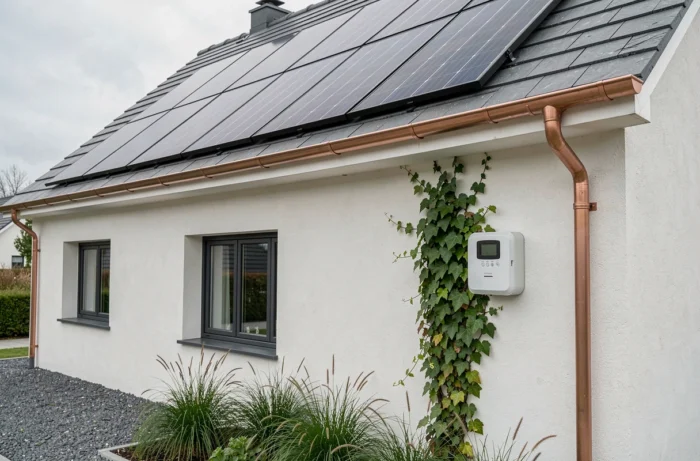
Residential solar in low-sunlight areas: actual production and misconceptions
Photovoltaics are still associated with the south of France. Recent data shows that residential solar is progressing faster in departments like Creuse or the Vosges than in some areas of the Mediterranean coast. The annual production there is indeed lower, but winter consumption (electric heating, extended lighting) creates a consumption profile compatible with high self-consumption in mid-season.
The orientation and inclination of the roof matter more than latitude. A south-facing roof inclined between 30 and 35 degrees in northern France captures enough sunlight to justify a solar project, especially with current panel prices.
Photovoltaic cells and efficiency: what matters on the ground
High-efficiency cells (like TOPCon or heterojunction) capture diffuse radiation better, which is common under a cloudy sky. For a house located in an area with low direct sunlight, the choice of cell technology influences production more than the installed area.
Excessive heat also degrades efficiency. Paradoxically, panels perform better in cool, bright weather than during heatwaves. A well-ventilated roof in Brittany can outperform an overheated roof in Var during the height of summer.
Residential solar in 2026 relies on precise calculations: sizing accurately, consuming what is produced, and no longer counting on resale to balance the budget. The S21 reform has simplified the financial logic by removing incentives for overproduction. It remains to adapt each project to the real constraints of the building, local climate, and household consumption profile.