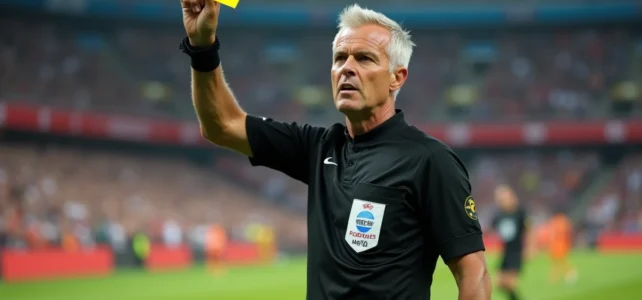
Each card shown by the referee during the 2026 World Cup triggers a financial invoice sent to the federation of the sanctioned player. The scale, set by FIFA in its Disciplinary Code, turns on-field indiscipline into an accounting charge for national bodies. The amounts vary according to the severity of the sanction, but the mechanism remains the same: the federation pays, not the player.
FIFA Fine Scale by Type of Card in the 2026 World Cup
Article 14 of FIFA’s Disciplinary Code establishes a progressive fine system. The heavier the sporting sanction, the higher the bill for the concerned federation.
Recommended read : How to Develop Your Professional Skills to Succeed in the Digital World
| Type of Sanction | Amount of Fine |
|---|---|
| Yellow card | 10,000 Swiss francs (approximately 10,000 dollars) |
| Second yellow card resulting in exclusion | 15,000 Swiss francs |
| Direct red card | 20,000 Swiss francs |
These amounts apply to each occurrence. A team that accumulates warnings sees the bill rise match after match, with no overall cap announced by FIFA.
To better understand how much a yellow card costs in the World Cup, one must look beyond the unit amount and consider the cumulative effect over the course of a tournament.
Recommended read : What to do if the Simu remote control for the roller shutter is not working anymore?

Fines and Performance Bonuses: Two Independent Financial Circuits
A logical reflex would be to think that a successful federation offsets its fines with performance bonuses paid by FIFA. This is not the case. The two financial flows operate on completely separate circuits.
Fines for cards are applied even if the team wins its matches or progresses in the tournament. A federation that reaches the semifinals with an undisciplined squad will pay all of its fines, with no deductions from its performance bonuses.
This compartmentalization has a direct consequence: federations with modest budgets bear a proportionally heavier impact. For a federation whose annual operating budget is in the hundreds of thousands of dollars, accumulating five or six yellow cards in the group stage represents a significant financial burden.
Who Pays the Bill in Practice
The player himself does not pay anything under FIFA regulations. It is the national federation that receives the fine and pays it. Some federations then pass the cost internally (deductions from individual bonuses, internal sanctions), but FIFA only deals with the member federation.
This system places financial responsibility at the institutional level. A player who gets angry in the quarterfinals does not see his bank account debited. His federation, however, receives the notification in the following days.
Concrete Case: The Bill for France – Spain in the 2026 World Cup
The match France – Spain in this edition generated 20,000 dollars in fines for the FFF. This amount corresponds to the accumulation of cards given to French players during the match.
Compared to a single match, the figure may seem modest compared to the overall budgets of professional football. Over the course of a tournament, the multiplication of matches changes the scale.
In contrast, the Netherlands received the fair play award of the 2026 World Cup with only three yellow cards conceded throughout the competition. Their total fine bill is therefore around 30,000 Swiss francs, one of the lowest amounts in the tournament.
Resetting Yellow Cards: At What Stage of the Tournament
The question of resetting yellow cards takes on a particular dimension in a tournament with 48 teams, a format adopted for this 2026 edition. The increased number of matches mechanically raises the risk of accumulation for players who are regularly cautioned.
From a sporting perspective, yellow cards condition suspensions: a player who accumulates a certain number of warnings misses the next match. The reset occurs at an advanced stage of the competition to prevent a player from being suspended in the final for cards received in the group stage.
From a financial perspective, however, no reset applies to fines. Each yellow card remains counted in the financial tally of the federation, from the first group match to a potential final.
Impact of the 48-Team Format on Fines
With more matches played by teams that advance far in the bracket, the expanded format mechanically produces more cards. The financial consequences follow the same curve:
- More matches mean more opportunities for fouls to be sanctioned, thus a higher potential for fines per federation
- Teams eliminated early pay less, not out of disciplinary virtue, but simply due to a reduction in the number of matches played
- Federations whose players compete in physical leagues (strong tackles, rough play) statistically present a higher financial risk profile
Fair Play as an Economic Strategy for Federations
The fair play award given to the Netherlands during this 2026 World Cup illustrates a double benefit. The first is reputational. The second is directly financial: three yellow cards over an entire tournament represent substantial savings compared to a team that would accumulate around twenty.
For medium-sized federations, the stakes go beyond symbolism. Limiting cards means preserving a budget that can be reallocated to training or infrastructure. FIFA’s Disciplinary Code, through its Article 14, creates a direct economic incentive for discipline.
The amounts remain denominated in Swiss francs, which exposes federations whose national currency is weaker to an additional exchange rate risk. A fine of 10,000 Swiss francs does not represent the same budgetary effort for the German federation as it does for a federation from West Africa or Southeast Asia.
The FIFA fine system for cards in the 2026 World Cup remains a mechanism that is not very visible to the general public, but is structuring for the finances of federations. With the transition to 48 teams and the increase in the number of matches, the overall bill for indiscipline has never weighed so heavily in the accounts of national bodies.