
You wake up to find aligned bites on your arms and small dark marks on the mattress. Doubt sets in: bedbugs may have colonized your home. The first reflex is often to check what your home insurance covers. The answer, in the vast majority of cases, is likely to disappoint you.
Why standard home insurance contracts exclude bedbugs
A multi-risk home insurance contract (MRH) covers sudden and unpredictable disasters: fire, water damage, theft. Bedbugs do not fall into this category. Insurers consider their presence to be a hygiene and regular maintenance issue for the home, similar to mold or cockroaches.
Related reading : How to Optimize Your Community's IT Management with Innovative Solutions
Specifically, the exclusion clause is found in the general conditions, often under the heading “damage caused by pests and nuisances.” Infestation does not cause material damage to the building’s structure: bedbugs do not gnaw at walls, cables, or furniture. They feed on human blood and hide in bedding, baseboards, and sofa seams.
To fully understand home insurance coverage against bedbugs, it is essential to distinguish between what constitutes a covered disaster and what falls under home maintenance.
Recommended read : How to Avoid Sweating Under a Hat: 8 Tips to Stay Dry
Some low-cost contracts that have emerged in recent years exacerbate the problem. With premiums of just a few euros per month, they exclude not only pests but also any assistance related to maintenance. The low price masks very extensive exclusions that many comparison sites do not detail.
Pest coverage as an option: what insurers really cover
Some insurers offer a “pest” or “pest assistance” option in their mid-range or premium plans. How does this coverage work?
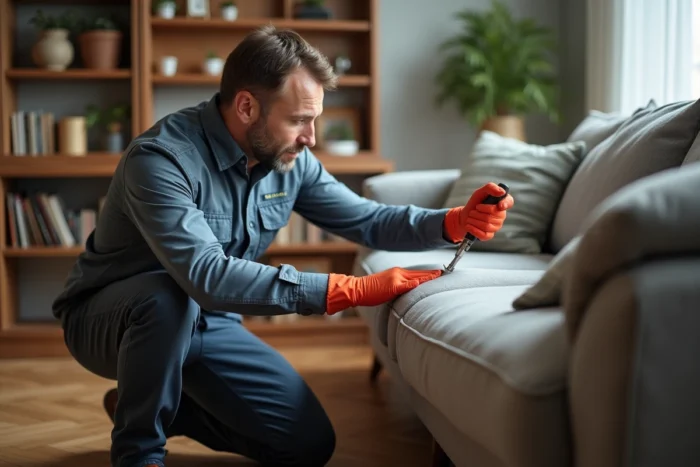
Generally, it covers the intervention of a pest control professional, under certain conditions. You call your assistance, an approved service provider comes out, and treats the home. The insurer pays the bill up to an annual limit, which is often modest.
Conditions to check before subscribing
- The waiting period: most contracts impose a waiting period after subscription, during which no coverage is possible. Subscribing after spotting bedbugs will be of no use.
- The intervention limit: some guarantees limit coverage to a single visit. For an established infestation, a single treatment is rarely sufficient.
- Specific exclusions: some contracts cover rats and cockroaches but explicitly exclude bedbugs. The mention of “pests” does not guarantee that all parasites are included.
- The type of intervention: some plans only fund a diagnosis, not the complete treatment. Others require a partner service provider, with no option to choose your professional.
Before committing, request the general conditions and look for the exact mention “cimex lectularius” or “bedbugs.” A “pest” guarantee without specification may be interpreted restrictively by the insurer at the time of the claim.
Tenant or owner: who pays for bedbug treatment
You are a tenant and discover an infestation. Your first point of contact is not your insurer; it is your landlord. Since the Elan law of 2018, the landlord must provide a pest-free home. This obligation pertains to the decency of the housing.
If the bedbugs were present before your arrival, the landlord is responsible for pest control. If the infestation occurs during the lease, the situation becomes more complex. The tenant is required to maintain the property and report the problem promptly.
How to prove the origin of the infestation
This is the most common point of contention. The landlord may argue that the tenant introduced the bedbugs via second-hand furniture or travel. The tenant can counter that the building was already infested.
A diagnosis performed by a certified professional constitutes evidence. Some pest controllers provide a report indicating the level of infestation and its likely age. Keep this report, written exchanges with the landlord, and treatment invoices.
In the event of a persistent dispute, the departmental conciliation commission or a local court can decide. CAF assistance for tenants in difficulty exists in certain situations, but it remains subject to resource and housing criteria.

Specialized bedbug contracts: a credible alternative
In light of the shortcomings of standard MRH contracts, new insurers have positioned themselves in this niche with dedicated offers. These contracts function like targeted insurance: you pay a monthly premium and, in the event of a confirmed infestation, the service provider intervenes.
The real interest depends on your situation. If you live in an old building in the city center, in an area with a high density of reports, this type of contract may be justified. If you live in a detached house with no history, the relationship between the accumulated premium and the actual risk deserves a cold calculation.
A professional treatment for a medium-sized apartment represents a significant cost, especially if multiple visits are necessary. Compare this amount to the annual premium of the specialized contract, factoring in the waiting period and any deductibles.
What these contracts do not cover
No contract, whether standard or specialized, reimburses the replacement of your mattress, sheets, or damaged clothing. Damage to furniture caused by bedbugs is not considered a compensable loss. The coverage pertains to pest control intervention, not the affected belongings.
Student contracts offered by some mutual insurance companies sometimes include pest assistance, but with very low limits and restrictive conditions. Read the general conditions before assuming that you are protected.
The best protection remains prevention: inspect second-hand furniture, use bedbug-proof covers on bedding, monitor for signs of infestation after traveling. If the problem arises nonetheless, first check your home insurance contract, identify the responsible party between landlord and tenant, and then have a certified professional intervene without waiting for the colony to establish itself permanently.