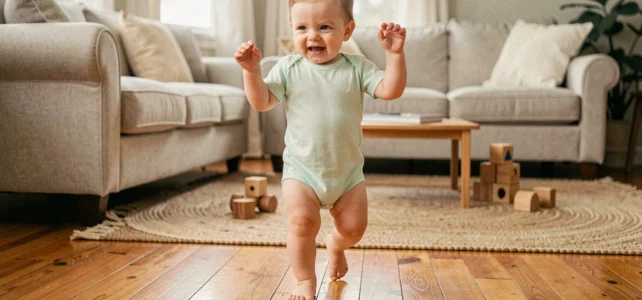
Most babies start walking between 10 and 18 months. This very broad window of normalcy, however, generates a lot of comparisons between children of the same age. Before venturing out on their own, a child goes through several intermediate motor stages that prepare their balance, coordination, and confidence. Supporting these first steps involves less physical intervention and more creating the conditions for the toddler’s body and mind to progress at their own pace.
Securing furniture and passage areas: ensuring safety before baby walks
Articles on baby’s first steps often discuss safety in general terms. The topic deserves a more concrete approach because the risk of falling increases precisely when a new motor skill is acquired. A child who walks along furniture pulls on everything they can grab. An unsecured dresser, a lightweight side table, or a floor lamp can become tipping hazards.
Related reading : Tips and Essential Steps to Create an Elegant Paved Garden Pathway
Securing tall furniture (bookshelves, dressers, shelves) to the wall is a preventive measure that is often postponed. This is done with anti-tip straps or brackets screwed into the wall. The cost is negligible, the setup takes just a few minutes, and the effectiveness is immediate.
Stairs represent another critical point. A safety gate at the top and bottom remains the most reliable measure. Windows located less than a meter off the ground deserve a window latch or block, especially on upper floors. The site Mes Petits Pas offers useful resources to identify suitable equipment for each stage of motor development.
Further reading : The best tips and advice for succeeding in online real estate
Also consider the floor. A non-slip surface (raw wood flooring, well-secured thin carpet) provides better grip than smooth tiles. The goal is not to eliminate all falls but to remove dangerous falls.
Active supervision or physical assistance: what truly promotes balance
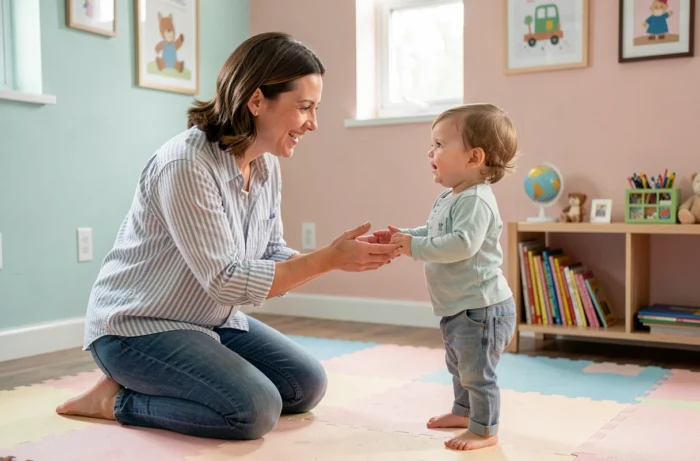
The most common parental reflex is to hold the child by the hands to help them move forward. Several specialists in psychomotricity point out that this practice can actually disrupt the toddler’s natural supports and sense of balance. When an adult pulls up, the child ends up in an artificial posture, arms raised, body weight poorly distributed.
Active supervision works differently. It involves staying close, on the ground if possible, without intervening as long as the child explores on their own. Crawling, pulling up along a sofa, letting go of support for a second: each of these micro-experiences strengthens the trunk and leg muscles.
This approach requires patience. A child who falls back onto their bottom after letting go of the furniture has not failed. They are calibrating their supports, adjusting their center of gravity, and processing the information. Letting the child fall (on a safe surface) is part of the learning process of walking.
Intermediate supports that prepare for independent walking
Before walking alone, a baby goes through distinct stages that parents may not always recognize:
- Standing up by gripping a low piece of furniture, then holding the position for several seconds without additional help
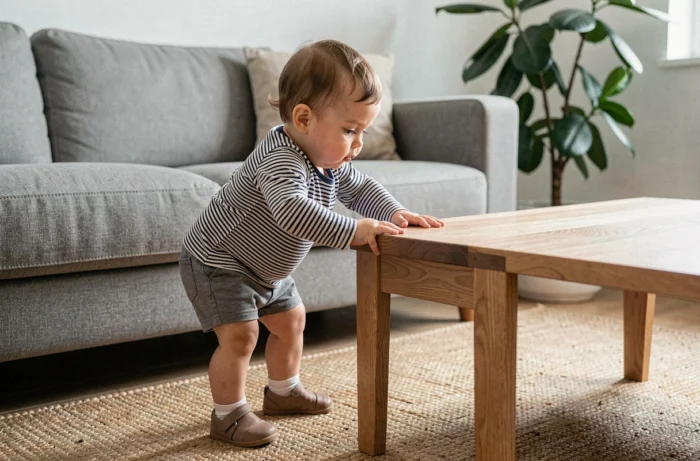
- Walking sideways along furniture (the “cabotage”), which develops leg coordination and the transfer of weight from one foot to the other
- Letting go of support to grab an object just out of reach, which requires initial balance without support
- Taking a few steps between two close supports (from a coffee table to a sofa, for example)
Each of these stages can last a few days or several weeks. The gap between children is considerable, and a baby who is not walking by 12 months is still within the normal development range.
Barefoot, slippers, or shoes: choosing footwear during the first steps
The debate resurfaces with each generation. Current recommendations converge on a simple principle: barefoot as much as possible indoors.
Being barefoot allows the baby to feel the ground, grip with their toes, and develop their proprioception (the perception of their body’s position in space). A soft leather slipper, without a rigid sole, is an alternative when the floor is cold or rough. It protects without hindering foot mobility.
Rigid-soled shoes are only useful outdoors, to protect the foot from roughness and cold. They do not “support” the ankle in the orthopedic sense of the term. A soft and flexible sole is preferable to a rigid high-top shoe for a child in the learning phase.
- Indoors: barefoot or soft slippers with a thin sole, without a rigid heel
- Outdoors on even surfaces: lightweight shoes with a soft and non-slip sole
- Outdoors on uneven surfaces: soft high-top shoes that cover the ankle without restricting it
When to consult a healthcare professional about baby’s walking
The great variability in the age of first steps makes the benchmarks unclear for parents. Some signals warrant medical advice, not to alarm, but to ensure that motor development is progressing normally.
If a child shows no interest in standing by 12 months, or if they do not pull up at all using furniture, a discussion with the pediatrician or family doctor can rule out a muscular or neurological difficulty. Similarly, a persistent asymmetry in posture or gait justifies a consultation.
Field feedback varies on this point: some professionals recommend a psychomotor assessment as soon as the parent has concerns, while others prefer to wait until 18 months before any investigation. In both cases, asking the question during a routine visit is enough to initiate the evaluation.
Independent walking is not a goal to tick off on a calendar. A child who crawls effectively at 14 months develops the same fundamental motor skills as an early walker. The parent’s role is to provide a safe environment, an appropriate floor, and the freedom to explore, then to observe without rushing.