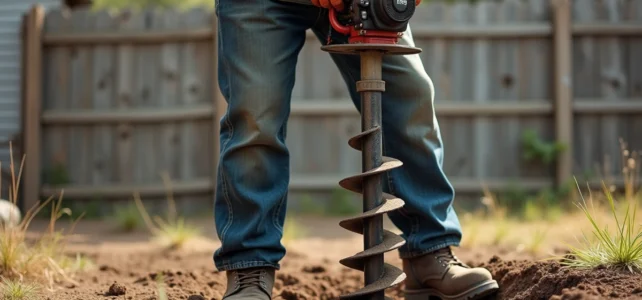
Reaching a depth of one meter with a gas-powered auger does not pose any mechanical difficulty: most models on the market cover this range without an extension. The real limiting factor is the nature of the soil and the management of the spoil in the last few centimeters.
Spoil management below 60 cm: the real bottleneck
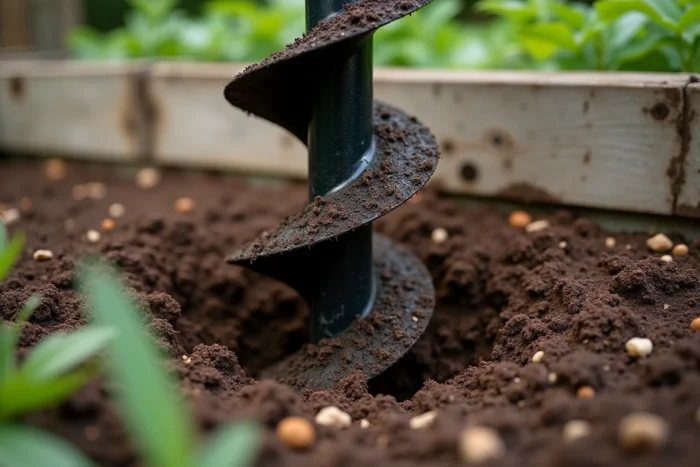
Beyond 60 cm, the standard auger bit poorly evacuates the soil. The coils become saturated, the motor struggles, and the operator compensates by pressing harder, which exacerbates the problem. We recommend working in successive passes of 20 to 30 cm, raising the bit after each pass to clear the accumulated spoil from the coils.
Further reading : How to Start in the Stock Market: Practical Tips and Strategies for Effective Investing
In wet clay soil, the spoil sticks to the coils and forms a compact blockage. Manually scraping the bit between each pass with a metal spatula prevents overloading the motor. This action takes a few seconds and extends the life of the clutch.
A detail rarely mentioned: pouring half a liter of water into the hole before the last pass facilitates penetration in dry and compacted soils. The moistened soil fragments better under the action of the tip, and the earth rises more easily along the coils.
Recommended read : Practical tips to avoid a fake fine in Italy during your trip
To fully understand the complete sequence and know how to dig a hole 1m deep with a gas-powered auger, the method of passes remains the foundation of any clean drilling.
Bit blockage at 80-100 cm: anticipating the backlash
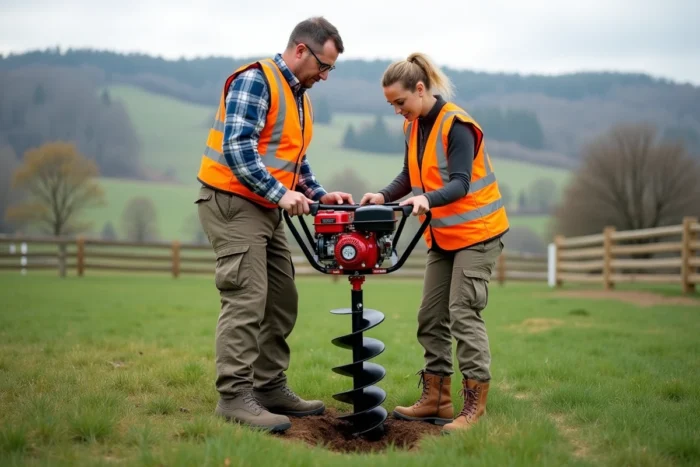
A sudden blockage of the bit generates a violent backlash torque transmitted to the handles. This phenomenon typically occurs between 80 and 100 cm, when the tip encounters a thick root, a buried stone, or a layer of soil denser than the rest of the profile.
Three concrete measures reduce the risk:
- Work with two people as soon as the bit diameter exceeds 150 mm or when the soil is heterogeneous, each operator holding a handle to absorb the torque
- Check the safety brake before each session: a worn or poorly adjusted brake allows the bit to continue spinning after releasing the trigger, turning a simple blockage into an accident
- Maintain a moderate engine speed in the last third of the drilling; full power adds nothing in already fragmented soil and amplifies the backlash in case of an obstacle
If the bit becomes completely blocked, cut the engine immediately. Attempting to force it by restarting the engine with the bit blocked can twist the drive shaft or break the coils. Manually clearing by turning the bit in reverse with the handles is sufficient in most cases.
Choosing the bit and diameter for one-meter drilling
The wide-pitch auger bit is the only rational option for a one-meter hole. The heart-shaped bit, sometimes supplied with the machine, is used for mixing substrates or for superficial widening. Using it for deep drilling leads nowhere.
The diameter is chosen based on the final use, not the power of the motor. For a fence post, a diameter slightly larger than the post allows for pouring concrete around it. For tree planting, a wider diameter facilitates the installation of the root ball and the filling with amended soil.
Extension or long bit
Some manufacturers offer drive extensions that allow drilling beyond the standard length of the bit. For one meter, a standard length bit is usually sufficient without an extension, provided that the spoil is well evacuated after each pass. Adding an extension to a one-meter hole complicates handling and increases vibrations without any real gain.
Adapting the technique to the type of soil
The behavior of the gas-powered auger changes radically depending on the terrain. We observe three main scenarios in practice.
Loose and sandy soil
Pentration is quick, sometimes too quick. The risk is to drive the bit in suddenly and drown the motor in the hole. Controlling the descent by releasing pressure and letting the weight of the machine do the work yields a cleaner result. The walls easily collapse in this type of soil, which widens the hole at the surface and reduces the useful depth.
Compact clay soil
Progress is slow and steady. Passes of 15 to 20 cm are preferable to 30 cm passes to avoid overheating the motor. Cleaning the bit between each ascent is essential, as clay forms a sheath around the coils that reduces their evacuation capacity to almost nothing.
Rocky or heterogeneous soil
The worst scenario for the gas-powered auger. Repeated shocks on the stones quickly wear down the tip and cause micro-blockages in series. Pre-drilling the soil with a mining bar before starting the auger helps identify major obstacles. If a rock block is in the trajectory, it is better to shift the hole a few centimeters than to force the machine.
Post-drilling maintenance of the gas-powered auger
After drilling several one-meter holes, the bit and motor have undergone sustained effort. Cleaning the bit with a water jet to remove any traces of soil (especially clay) prevents corrosion of the coils. Check the condition of the tip after each deep drilling session: a dull tip doubles the effort required for the next drilling.
On the motor side, check the oil-gas mixture level and the condition of the air filter after intensive use. Fine soil dust infiltrates everywhere and clogs the filter much faster than surface use.
One last practical point: store the auger bit disassembled and the tip protected by a sleeve. The tips of the helical bit are sharpened at the factory, and a shock during storage is enough to dull them, which will be felt at the next hole.