
The municipal road network represents the vast majority of the French road system. Each municipality manages an average of about fifteen kilometers of roadways, sidewalks, and paths, a heritage that can absorb a significant part of its investment capacity. Ensuring sustainable management of municipal roads requires mastering both the legal framework, maintenance techniques, and the new environmental constraints that weigh on public works contracts.
Digital Passport and European Regulation on Road Materials
The regulation (EU) 2024/3110 on construction products, adopted in December 2024, changes the game for local authorities that award road contracts. Manufacturers of materials (asphalt, curbs, gutters) must now declare 19 environmental indicators based on a complete life cycle analysis, according to standard EN 15804.
Read also : Test and review of Leclerc fruit alcohol for macerating your homemade preparations
This data is no longer part of a voluntary approach. It becomes regulatory declarations verified by a third-party organization (system 3+). The technical specifications of public road contracts will gradually incorporate the requirement to provide this information for each material used.
This regulation aligns with European regulations on eco-design via the Digital Product Passport. In practice, each material has a digital identity card (often a QR code) that includes technical performance, environmental data, traceability, and useful information for reuse or recycling. For a municipality, structuring its contracts around the management and maintenance of municipal roads now involves the systematic archiving of these environmental performance declarations.
You may also like : The best tips and advice for succeeding in online real estate
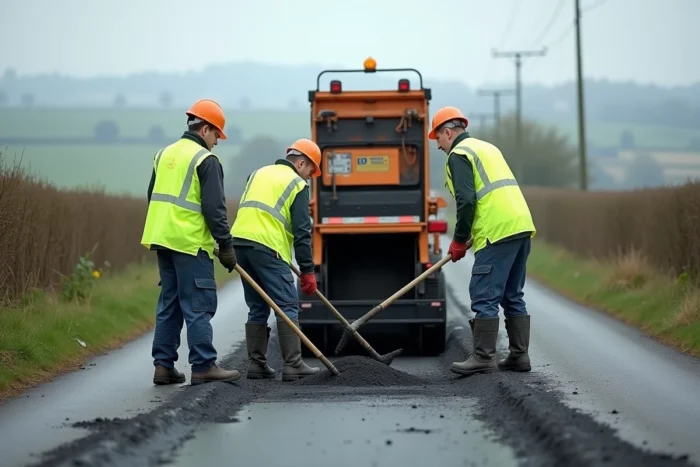
Distinction Between Municipal Roads and Rural Paths: Consequences for Maintenance
The road network of a municipality does not form a homogeneous legal block. The municipal roads belong to the public road domain: they are inalienable, imprescriptible, and have been officially classified. The municipality is obligated to maintain them.
The rural paths, on the other hand, fall under the municipality’s private domain. They are designated for public use without formal classification. This difference has direct consequences on the liability regime and the budgets to be mobilized.
- A degraded municipal road engages the municipality’s liability for normal maintenance failure of the public work, with a presumption of fault regime.
- A rural path does not create the same obligation for regular maintenance, but the municipality is still required to report known dangers.
- The declassification or classification of a road follows an administrative procedure (public inquiry, municipal council resolution) that permanently alters the maintenance responsibilities of the community.
Before scheduling works, accurately identifying the legal status of each section helps avoid expenses on roads whose maintenance is not the municipality’s responsibility, or conversely, neglecting sections where its liability is engaged.
Multi-Year Programming of Road Works
The frequent temptation is to address degradations as they arise, by patching potholes as needed. This reactive approach is much more expensive than a structured preventive strategy.
A multi-year programming relies on an initial diagnosis of the network’s condition. Several methods exist, from systematic visual surveys (conducted in-house) to instrumented inspections offered by specialized service providers. The goal is to classify each section according to its level of degradation and prioritize interventions.
Three Levels of Intervention to Distinguish
Routine maintenance (filling cracks, localized reprofiling) preserves the lifespan of the roadway at a lower cost. Structural maintenance (renewal of the wearing course) occurs when the surface can no longer be maintained by spot repairs. Complete reconstruction, by far the most expensive, should only be considered when the road structure is compromised.
Delaying structural maintenance turns a moderate expense into heavy reconstruction. The ratio between the cost of preventive maintenance and that of a complete overhaul can vary considerably, justifying the sanctification of an annual road budget even during periods of budgetary constraints.

Conservation Police of the Municipal Road Domain
The mayor exercises the conservation police of the public road domain over municipal roads. This special police power allows him to regulate road occupations, set conditions for network connections, and impose restoration after works carried out by third parties (network concessionaires, developers).
In practice, two tools structure this police:
- The road permission, which authorizes an occupation encroaching on the public domain (trench, laying of pipelines, installation of furniture). It sets the technical restoration requirements.
- The municipal road regulation, which codifies the rules applicable to any intervention on the roadway or sidewalks: trench depth, repair deadlines, materials to be used, coordination among interveners.
- Temporary traffic orders, necessary during construction to ensure user safety and organize detours.
A precise and enforced road regulation prevents third-party interventions from degrading the roadway without compensation. The quality of restoration after trenching directly affects the lifespan of the surface.
Integrating Soft Mobility into Municipal Road Renovation
Each renovation campaign presents an opportunity to rethink the sharing of public space. Rather than replicating the existing cross-section, the municipality can reallocate part of the roadway width to cycling or pedestrian facilities, provided that the dimensions allow it.
This approach, known as road reallocation during works, limits additional costs compared to a standalone cycling development project. Ground marking, installation of separators, or raising a sidewalk can be integrated into the resurfacing project without mobilizing a second market.
Considering civil engineering structures (bridges, footbridges, retaining walls) complements this reflection. These structures, of which there are a significant number in the municipal network, require regular inspections and technical monitoring distinct from that of the roadways. Their degradation can lead to costly road closures and safety risks.
The management of municipal roads is not just about filling holes. It involves legal frameworks, budget programming, new environmental requirements, and adapting road profiles to current uses. Municipalities that structure these four axes into a multi-year programming document limit their long-term costs and reduce their exposure to litigation related to maintenance failures.