
The size indicated on a children’s clothing label rarely corresponds to a universal measurement. Each brand applies its own sizing charts, and a “4 years” in one brand may equate to a “5 years” in another. When the label is missing (second-hand clothing, gift without packaging, label cut for comfort), there are still reliable indicators to identify the actual size of the garment, provided you know what to measure and where.
Fit Profile: The Sheet to Keep on Your Phone
Before even looking for the size of a garment, the most effective approach is to create a fit profile for each child. The principle is simple: note in a notes app or a spreadsheet the updated measurements (total height, chest circumference, waist circumference, inseam, shoe size) and update them every two to three months.
This profile replaces the logic of “age = size,” which can be misleading as soon as the child deviates from the average curve. It also allows for direct comparison of a garment found in a thrift store or on a marketplace with concrete data, without relying on a label.
Adding the preferred fit type (fitted or loose) and an acceptable growth margin to the profile helps to find the right size without a label even during a quick online purchase. Keeping a history of brands that run small or large helps avoid repeating the same mistakes from season to season.

Measuring a Children’s Garment Without a Label: The Key Areas
A flexible measuring tape and a flat surface are sufficient. The garment should be laid flat, buttoned or zipped, without stretching it.
Tops: T-shirts, Sweaters, Jackets
- The shoulder width is measured from one armhole seam to the other, following the collar line. This is the most discriminating measurement for tops, as it varies little between brands for the same actual size.
- The total length, from the highest point of the shoulder to the bottom hem, gives a direct indication of the size range (in centimeters of the child’s height).
- The chest circumference is calculated by measuring the width of the garment under the armpits and then multiplying by two. Comparing this value to the child’s chest circumference allows you to check for ease.
Bottoms: Pants, Shorts, Skirts
For pants, the determining measurement is the inseam: from the center seam to the bottom of the leg. This length, crossed with the waist circumference of the garment (half-waist measured flat, multiplied by two), is sufficient to identify if the pants fit the child’s profile.
For shorts or skirts, the total length from the waistband and the waist circumference remain the two main indicators. Children’s brands generally align the size in centimeters with the child’s height: pants intended for a child measuring 104 cm will bear the label “104” if the label exists.
Size-Height Correspondence in Centimeters for Children’s Clothing
Most European brands use the child’s height as the basis for their sizing charts. Size 110 corresponds to a child of about 110 cm, size 116 to 116 cm, and so on in increments of 6 cm. This logic works from birth (size 50-56) up to pre-adolescence (size 164-170).
When the label is missing, measuring the garment flat and comparing the obtained dimensions to a reference garment of known size remains the most direct method. Keeping a “benchmark garment” for each size range in the child’s closet (a T-shirt that fits perfectly, for example) allows for quick comparisons.
| Child’s Height (cm) | Current Clothing Size | Indicative Age |
|---|---|---|
| 86-92 | 86/92 | 18 months – 2 years |
| 98-104 | 98/104 | 3-4 years |
| 110-116 | 110/116 | 5-6 years |
| 122-128 | 122/128 | 7-8 years |
| 134-140 | 134/140 | 9-10 years |
Age remains purely indicative. Two children of the same age can show a significant height difference, making measuring in centimeters much more reliable than the label “4 years” or “6 years.”
Second-Hand and Unlabeled Clothing: Reflexes to Adopt
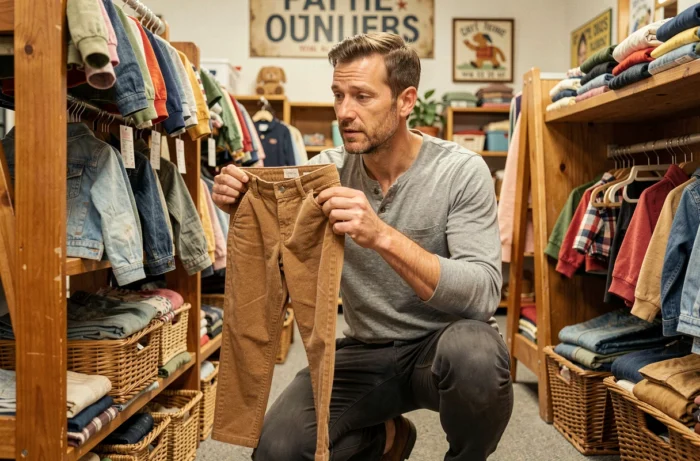
Buying second-hand children’s clothing (thrift stores, wardrobe sales, marketplaces like Vinted) multiplies the situations where the label has been removed or has become unreadable. A few habits significantly reduce the risk of error.
Asking for flat measurements from the seller before purchasing online has become common. A seller who refuses or cannot measure a garment often indicates an unreliable listing. Flat measurements are more useful than the stated size in the description, as the indicated size may come from a brand that runs small or large.
In physical stores (thrift shops, recycling centers, consignment shops), bringing the measurement profile on your phone and a sewing tape measure allows you to check any garment in less than a minute. Comparing the shoulder width and the length of the garment to the recorded profile gives a more reliable result than a quick fitting, especially if the child is not present.
Growth Margin: How Much to Allow Without the Garment Being Baggy
Buying a garment slightly too big to “make it last” is a common reflex, but excessive margin hinders the child’s movements, especially in daycare or school. One size up is enough to accommodate a few months of growth for everyday tops and pants.
For fitted clothing (baby bodysuits, underwear, swimsuits), it’s better to choose the exact size. An oversized bodysuit gapes at the shoulders and does not hold the diaper. Conversely, jackets, coats, and sweatshirts tolerate an additional size better due to their looser cuts.
Regularly measuring the child and updating the data in the fit profile allows for spotting growth spurts before pants become too short. It’s a simple habit that avoids emergency purchases and garments worn only twice.