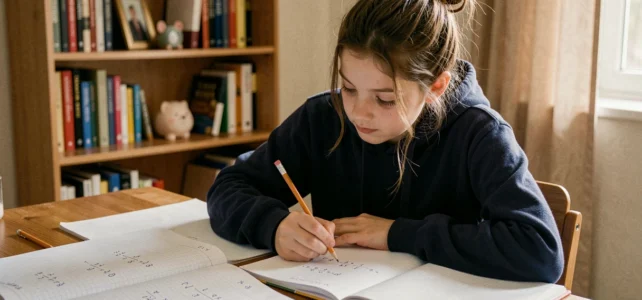
In middle school, math problems do not only test the ability to calculate. The difficulty often lies much more in translating a statement into usable mathematical relationships. A student who masters their tables and formulas can fail at a three-line problem simply because they do not know where to start.
Decoding the statement before calculating: the real bottleneck in middle school math
Recent research on problem-solving in middle school converges on one observation: most errors do not come from the calculation itself. They arise when the student tries to understand what the text is asking them. Decoding, representing, and planning are three steps that precede any operation, and this is precisely where middle school students struggle.
You may also like : Find an alternative to Format Factory for Linux: our recommended solutions
Specifically, decoding a statement means identifying useful data, discarding unnecessary information, and rephrasing the question in their own words. An effective exercise is to ask the student to rewrite the statement without numbers, using only words, to check that they have understood the situation described.
Adopting a method for solving math problems in middle school relies first on this ability to transform text into a mental diagram. As long as this step remains unclear, multiplying calculation exercises does not yield lasting progress.
Further reading : How to Start in the Stock Market: Practical Tips and Strategies for Effective Investing
The difficulty comes from translating the text, not from the calculation. A 5th-grade student capable of solving a simple equation may get stuck on a concrete problem because they do not know which equation to set up. The work of decoding deserves as much time as technical training.
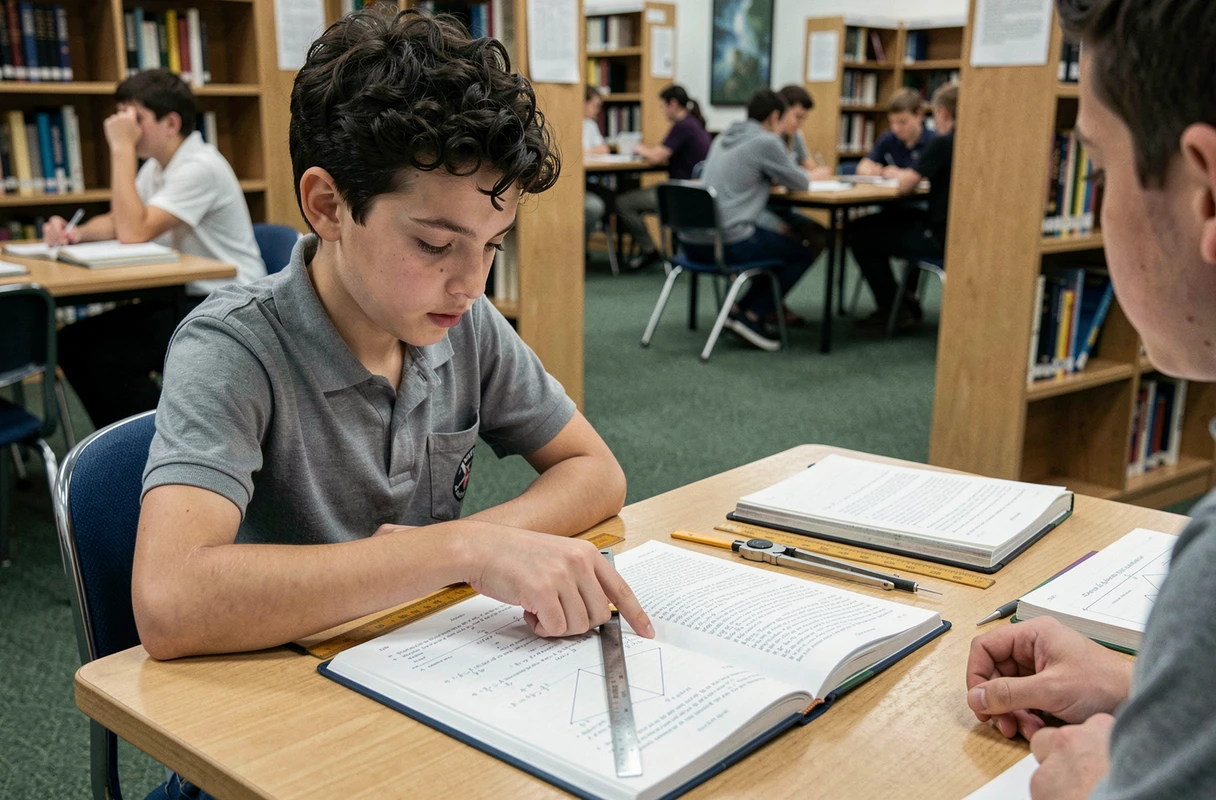
Active error correction: a routine missing from most school practices
Rereading a solution is not enough. Passive correction (reading the solution, nodding, moving on) leaves the causes of the error intact. A more effective approach, recommended by several recent resources, relies on three distinct phases:
- Redo the failed exercise entirely, without looking at the solution, to pinpoint exactly where the reasoning goes off track.
- Write down the cause of the error: confusion between two concepts, misreading the statement, forgetting an intermediate step, sign error.
- Revisit the same exercise a few days later to check that the correction has been properly integrated, and not just memorized in the short term.
Redoing a failed exercise and then revisiting it a few days later has a measurable effect on retention. This routine goes far beyond simply rereading the solution, which remains the dominant practice among middle school students.
The error notebook (a dedicated notebook where the student records their recurring mistakes along with the associated explanation) serves as a concrete tool to structure this work. It also allows the student to identify patterns: if they consistently make mistakes with unit conversions or setting up equations for a geometric problem, they know where to focus their efforts.
Regular mini-sessions instead of long revisions: adapting the pace of math work
A logic of short and frequent sessions is gaining ground in recent educational recommendations. The idea is to replace the one-hour review session the night before the test with shorter sequences spread throughout the week.
A typical mini-session can follow this progression:
- Quick course recap (rereading a definition, property, or key formula).
- Two or three quick drills (short calculations, notable identities, conversions) to maintain technical fluency.
- A guided problem where the student applies the complete process: reading, identifying data, choosing a method, writing the solution, verifying.
- A mini-personal assessment (the student rates on a simple scale whether they succeeded alone, with help, or not at all).
Short and repeated sessions consolidate the method better than a long one-time review. This division promotes long-term memory retention and reduces the cognitive load of each session.
In 6th and 5th grades, these sequences can last about fifteen minutes. In 4th and 3rd grades, where problems become longer and involve more cross-concepts, around twenty minutes per session remains a realistic format.
Differentiating exercises according to the targeted objective
Not all exercises serve the same purpose. A student discovering a concept does not need the same type of problem as one preparing for a test or correcting an identified gap. Not doing the same exercises depending on whether you want to understand, practice, or correct is a common-sense principle that is rarely applied.
To understand a new concept, direct application exercises (one step, one tool) allow verification that the lesson is assimilated. For practice, multi-step problems that combine concepts from the current chapter with prior knowledge are more suitable. To correct a specific error, revisiting a targeted exercise is better than redoing a complete series.
Writing the solution: a technical skill in its own right in middle school
Many middle school students lose points not because they did not find the answer, but because they do not know how to present it. Mathematical writing is a skill distinct from reasoning, and it should be taught as such.
A correctly written solution follows a visible logical sequence: recalling the property or theorem used, applying it to the problem’s data, calculating, then a concluding sentence that answers the question posed. Each step must be explicit. A correct result without justification remains incomplete in the eyes of a grader.
The habit of checking the consistency of the result closes the loop. A negative price, a length greater than the total perimeter, a percentage exceeding the whole: these inconsistencies become obvious when one takes the reflex to reread their answer in light of the problem’s context.
The most productive method is the one that the student applies regularly, not the one they know theoretically. A simple protocol (decoding the statement, choosing the tool, writing each step, verifying the result) becomes a reflex as long as it is repeated on varied problems, in short sessions, with active error correction. The consistency of work matters more than its duration.